
The most resilient energy portfolios in 2026 aren't built on speculative exploration but on a disciplined, layered defense that treats technical precision as a financial safeguard. While Brent crude hovers near $95.55 per barrel and geopolitical tensions in the Strait of Hormuz maintain a high risk premium, the margin for error in the junior sector has narrowed. De-risking oil and gas investments now requires a shift away from the "all or nothing" mentality of traditional wildcatting toward a sophisticated model of resource development. You likely recognize that market volatility and the looming threat of "dry hole" projects can erode even the most promising capital allocations.
This article provides the strategic framework you need to navigate these uncertainties with institutional confidence. You'll master the technical and operational methodologies used to mitigate exploration risk and maximize value within the Western Canadian Sedimentary Basin. We'll preview a comprehensive checklist for evaluating energy assets. We also explain how high insider ownership and enhanced oil recovery (EOR) techniques effectively lower a company's risk profile. By the end of this guide, you'll understand how to identify stability in conventional resources and realize the full potential of your energy sector commitments.
Key Takeaways
- Learn how de-risking oil and gas investments in 2026 shifts the focus from speculative discovery toward the technical optimization of proven, conventional resources.
- Discover how Enhanced Oil Recovery (EOR) and precise geological modelling serve as essential safeguards to extend asset lifecycles and stabilize production volumes.
- Understand the importance of high insider ownership and public equity listings in aligning corporate leadership with shareholder interests for enhanced financial transparency.
- Gain a clear framework for evaluating energy assets within the Western Canadian Sedimentary Basin, leveraging its reputation for operational stability and infrastructure access.
- Identify the specific "red flags" in junior energy portfolios that signal unmitigated exploration risk or strategic misalignment with current market conditions.
What is De-risking in the Oil and Gas Sector?
De-risking is the systematic methodology of identifying, quantifying, and neutralizing technical and financial uncertainties before capital is deployed. It's not merely a safety protocol; it's a comprehensive framework that transforms speculative ventures into predictable energy assets. For sophisticated operators, de-risking oil and gas investments involves a transition from high-stakes guesswork to a disciplined model of resource development. In 2026, the industry's focus has pivoted away from the simple act of "finding oil" toward the rigorous optimization of the economics surrounding known resources. This shift is particularly vital for junior producers within the Western Canadian Sedimentary Basin (WCSB), where the ability to realize value depends on precision rather than luck.
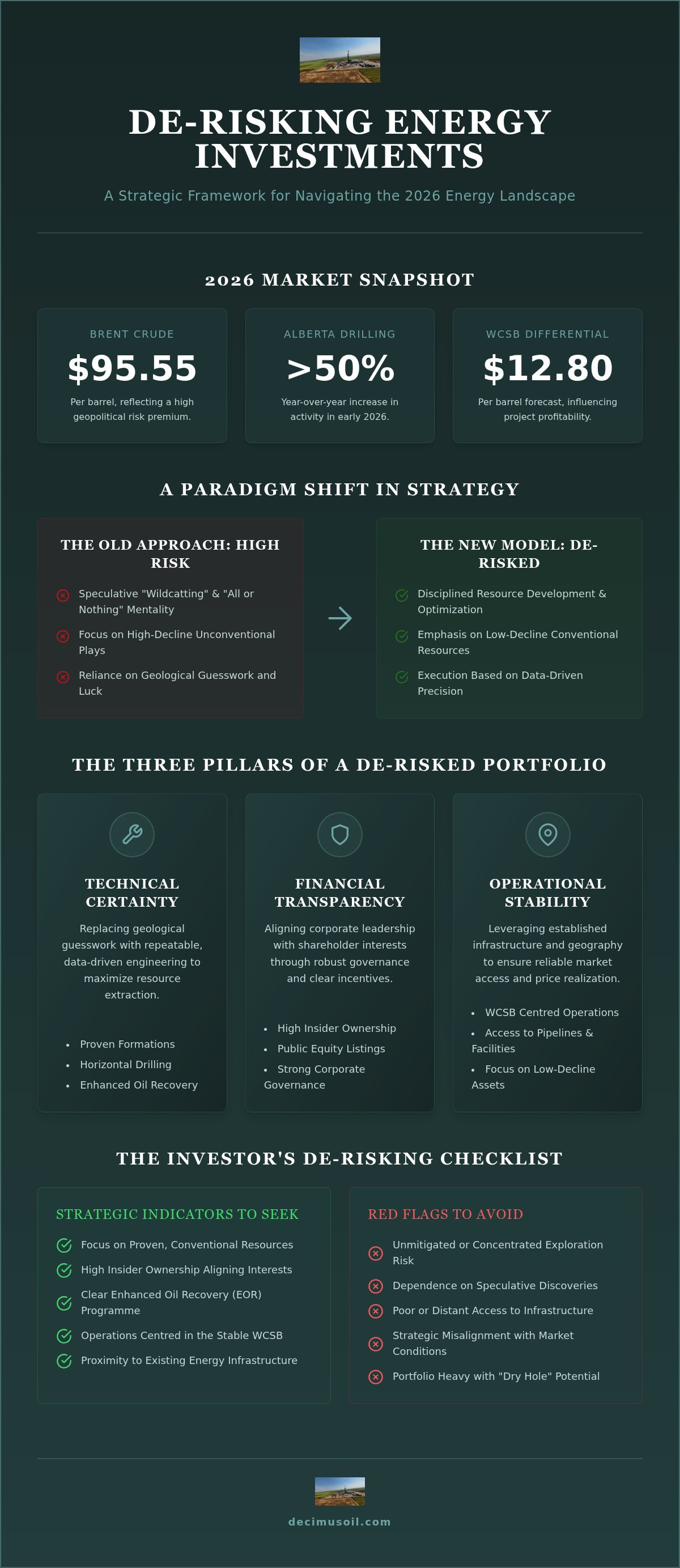
A robust de-risking strategy rests on three core pillars: technical certainty, financial transparency, and operational stability. When these pillars are aligned, the risk profile of a project drops significantly, allowing for more favourable capital allocation and institutional confidence. By applying established Risk management principles to the petroleum sector, companies can navigate the complexities of reservoir performance and market volatility with a steady, results-oriented narrative.
The Evolution of Risk in Canadian Energy
The Canadian energy landscape has undergone a profound transformation. There is a noticeable movement away from high-risk, high-decline unconventional plays toward the stability of conventional exploration. This evolution is driven by the need for low-decline assets that provide consistent cash flow. Technological advancements in 2026 have effectively turned what was once "exploration" into a "development" programme. With drilling activity in Alberta rising by more than 50% year-over-year in early 2026, the focus is now on leveraging existing energy infrastructure to ensure market access. Proximity to pipelines and processing facilities is no longer an afterthought; it's a primary de-risking tool that protects against infrastructure bottlenecks and ensures optimal price realizations.
Distinguishing Technical vs. Commercial Risk
Successful de-risking oil and gas investments requires a clear distinction between technical and commercial challenges. Technical risk focuses on the geological probability that hydrocarbons exist and can be extracted with modern engineering. We mitigate this through enhanced oil recovery (EOR) techniques and sophisticated reservoir modelling. Commercial risk, conversely, involves the ability to bring those hydrocarbons to market at a profit. This is influenced by the WCSB differential, which is forecasted at US$12.80/bbl for 2026, and the broader high-interest-rate environment. A balanced approach that addresses both geological certainty and corporate governance is essential for achieving long-term capital appreciation and protecting shareholder value.
Technical Mitigation: Geology and Enhanced Oil Recovery
Technical mitigation begins with the disciplined selection of geological targets. In 2026, the industry has largely moved away from speculative wildcatting in favour of conventional exploration within proven formations. By targeting reservoirs with documented production histories, operators significantly reduce the "dry hole" risk that often plagues junior energy portfolios. Horizontal drilling and high-intensity completions have transitioned from innovative to essential; they allow for maximum reservoir exposure and more efficient resource extraction. These engineering advancements are fundamental to de-risking oil and gas investments, as they replace geological guesswork with repeatable, data-driven precision.
The focus on technical certainty is evident in the Western Canadian Sedimentary Basin, where Alberta drilling activity saw a year-over-year increase of more than 50% in early 2026. This surge is driven by a commitment to resource development in areas where the geology is well understood and the infrastructure is already in place. Technical de-risking involves several key components:
- Applying horizontal drilling to maximize reservoir contact and improve recovery factors.
- Utilizing high-intensity completions to enhance flow rates in tighter formations.
- Implementing pressure maintenance through waterflooding to stabilize production levels.
The Role of Enhanced Oil Recovery (EOR)
Enhanced Oil Recovery (EOR) serves as a powerful mechanism to revitalize mature assets and extend their economic life. The global EOR market is estimated to reach $57.9 billion in 2026, with the thermal segment expected to account for 35.6% of that total. By implementing waterflooding or CO2-EOR, companies can maintain reservoir pressure and counteract natural decline rates. This creates a more predictable production profile, which is vital for long-term financial planning and dividend stability. Approximately 137 billion barrels of oil are technically recoverable using CO2-EOR, providing a significant opportunity for resource optimization. Such technical strategies often complement larger policy and financial de-risking initiatives by providing tangible, physical certainty to stakeholders.
Infrastructure as a Value Buffer
Controlling the value chain through energy infrastructure management is another layer of technical defense. When an operator owns its pipelines and processing facilities, it eliminates the uncertainty of third-party scheduling and escalating midstream costs. This is particularly relevant in Western Canada, where infrastructure access often dictates the viability of a project. A portfolio that integrates production with infrastructure is better equipped to handle the US$12.80/bbl WCSB differential forecasted for 2026. Direct control over transportation and processing creates a value buffer that protects margins during periods of market fluctuation. For investors seeking exposure to these technical safeguards, evaluating companies with established conventional oil and gas exploration programmes is a prudent first step toward realizing consistent value.
Financial De-risking: Public Equity and Corporate Governance
Financial de-risking is the fiduciary counterpart to technical precision. While geological data secures the physical asset, corporate structure and capital allocation strategies secure the investment itself. A core component of de-risking oil and gas investments involves selecting companies that prioritize low-decline conventional assets over high-risk speculative plays. These assets provide the steady cash flow necessary to weather market volatility, particularly in a high-interest-rate environment where the Bank Prime Loan Rate remains at 6.75%. Diversifying a resource portfolio across multiple proven pools further protects against localized production shocks, ensuring that a single operational delay doesn't compromise the entire enterprise's valuation.
Sophisticated investors look beyond the reservoir to the framework of the company. Utilizing established De-risking tools and mechanisms, such as robust balance sheet management and transparent reporting, allows an operator to maintain institutional stability. This approach ensures that capital is deployed efficiently to realize the highest possible return on investment while maintaining a commitment to professional integrity.
Aligning Interests Through Insider Ownership
High insider ownership is perhaps the most reliable signal of a de-risked governance model. When management maintains a significant stake, typically exceeding 25%, their financial outcomes are directly tethered to those of the shareholders. In the junior energy sector, this "skin in the game" ensures that capital is deployed with extreme discipline rather than reckless expansion. For example, maintaining over 27% insider ownership aligns leadership's focus on realizing long-term value. This commitment is bolstered by over 100 years of combined team experience, providing the seasoned perspective required to navigate complex commodity cycles and regulatory shifts within the Western Canadian Sedimentary Basin.
The Liquidity Advantage of Public Listings
Publicly listed entities offer a level of transparency and liquidity that private ventures often lack. A listing on the TSX Venture Exchange (TSXV:WCSB) requires rigorous financial reporting and continuous disclosure, acting as a built-in risk filter for investors. This transparency allows for a clearer evaluation of a company's balance sheet resilience and its ability to manage debt. Effective de-risking oil and gas investments also relies on the liquidity provided by public equity, allowing investors to adjust their positions as market conditions evolve. By maintaining a lean corporate structure and focusing on liquidity, companies ensure they have the financial flexibility to optimize existing assets even when U.S. 10-Year Treasury Yields remain elevated at approximately 4.75%.
Operational Stability in the WCSB
The Western Canadian Sedimentary Basin (WCSB) represents the cornerstone of operational stability for sophisticated operators. Unlike frontier exploration projects that carry immense geopolitical and technical uncertainty, the WCSB offers a globally recognized, low-risk jurisdiction with established regulatory frameworks. In an era where geopolitical tensions in the Strait of Hormuz keep global oil prices elevated, the predictability of Canadian conventional resources becomes a primary tool for de-risking oil and gas investments. Operational efficiency here isn't just about maintenance; it's about strategic alignment with infrastructure to ensure that every barrel produced reaches the market with minimal friction.
By focusing on the WCSB, companies capitalize on a mature energy ecosystem that supports every stage of the asset lifecycle. This includes everything from initial discovery to the revitalization of mature pools. Reducing "lifting costs" through direct control of operations and infrastructure is essential for maintaining margins during periods of price fluctuation. This disciplined approach ensures that the growth narrative remains grounded in results rather than speculation.
WCSB: A Proven Resource Landscape
The WCSB is defined by its vast historical data and proven geological formations. This wealth of information allows operators to refine drilling techniques and resource extraction methods with a high degree of certainty. In early 2026, Alberta drilling activity rose by more than 50% year-over-year, reflecting a collective industry pivot toward these stable, conventional assets. By leveraging decades of technical knowledge, companies transition from speculative exploration to disciplined development. This reduces the probability of operational surprises and ensures that capital is deployed where success is statistically most likely. The basin remains the centre of Canadian energy investment because it offers a level of geological predictability that few other regions can match.
Lifecycle Management and Asset Revitalization
Effective lifecycle management involves identifying under-developed assets that are prime for revitalization through modern completion techniques. Instead of solely focusing on greenfield exploration, operators maximize value by applying horizontal drilling and high-intensity completions to mature oil fields. This strategy significantly lowers operational risk, as the presence of hydrocarbons is already confirmed. It's an economic model that prioritizes the bottom line, allowing for healthy margins even when the WCSB differential is forecasted at US$12.80/bbl for 2026. Maintaining a pipeline of these revitalization projects ensures consistent resource growth without the volatility associated with unproven plays. It's a calculated approach that aligns technical nuances with shareholder value. To understand how these frameworks are applied to maximize potential, learn more about our resource development strategies in the WCSB.
The Investor’s De-risking Checklist
Building a resilient energy portfolio in 2026 requires moving beyond surface-level metrics and speculative headlines. Investors must adopt a rigorous due diligence process that scrutinizes the technical, operational, and financial foundations of a company. This checklist serves as a summarized framework for de-risking oil and gas investments, allowing for a clear-eyed assessment of whether a junior producer is positioned for long-term value or is merely a speculative gamble. By applying these criteria, you can identify operators that combine modern technical methodologies with institutional stability.
Technical and Operational Checklist
The physical asset is the first line of defense against capital loss. A de-risked portfolio prioritizes geological certainty and infrastructure control to protect margins. When evaluating an energy stock, verify the following:
- Asset Composition: Conventional resources typically offer lower decline rates and more predictable recovery profiles compared to unconventional shale plays.
- Production Maintenance: The presence of Enhanced Oil Recovery (EOR) programmes is a critical indicator of professional lifecycle management. These techniques stabilize production and extend the economic life of mature pools.
- Infrastructure Control: Companies that own or manage their gathering systems and processing facilities are better insulated from the volatility of third-party fees and midstream bottlenecks.
Financial and Governance Checklist
Corporate structure often dictates how well a company survives commodity cycles. Governance must align management's incentives with those of the equity holders. Use these benchmarks to filter your selections:
- Insider Alignment: High insider ownership is a primary signal of confidence. Look for levels exceeding 20% to ensure that management's capital is at risk alongside yours. Decimus Oil Corp. maintains over 27% insider ownership to ensure this strategic alignment.
- Regional Expertise: Verify that the leadership team has a proven track record specifically within the Western Canadian Sedimentary Basin. For example, Decimus leverages over 100 years of combined team experience to navigate the technical nuances of the region.
- Capital Allocation: Prioritize companies that balance per-share growth with operational stability rather than those pursuing aggressive, unproven exploration at any cost.
Identifying "red flags" is equally important. Avoid companies with high debt-to-cash-flow ratios, especially while the Bank Prime Loan Rate remains elevated. Be wary of "pure-play" exploration firms that lack a baseline of cash-flowing conventional assets. A public listing on the TSX Venture Exchange provides a layer of regulatory oversight and liquidity that private entities simply cannot match. Discover how Decimus Oil Corp. (TSXV:WCSB) applies these de-risking strategies to optimize asset value and protect shareholder interests in the WCSB.
Securing Value through Strategic Energy Alliances
The transition toward a de-risked energy portfolio requires a departure from speculative wildcatting in favour of disciplined, technical optimization. By prioritizing conventional assets and leveraging enhanced oil recovery (EOR), operators effectively stabilize production and extend the economic lifecycle of proven reservoirs. Success in de-risking oil and gas investments isn't just about geology; it's about robust corporate governance where high insider ownership ensures management's objectives remain perfectly aligned with shareholder interests. The Western Canadian Sedimentary Basin continues to offer a low-risk jurisdiction where institutional stability and modern engineering converge to create predictable growth.
Decimus Oil Corp. embodies these principles through its commitment to over 27% insider ownership and a team possessing more than 100 years of combined industry experience. Our focused approach to conventional resource development and infrastructure management provides a robust framework for realizing consistent value. Explore investment opportunities with Decimus Oil Corp. (TSXV:WCSB) to discover how technical precision and operational transparency are shaping the future of Canadian energy. It's the right moment to position your portfolio for resilience in the evolving 2026 landscape.
Frequently Asked Questions
What is the most significant risk in oil and gas exploration?
The most significant technical risk is geological uncertainty, specifically the potential for a "dry hole" where no commercial hydrocarbons are discovered. This outcome can lead to total capital loss for a specific project. Sophisticated de-risking oil and gas investments involves targeting proven conventional formations with extensive historical data. By focusing on development rather than speculative wildcatting, companies minimize this exposure and ensure more predictable capital deployment across their portfolios.
How does insider ownership help de-risk an investment?
High insider ownership, such as the level exceeding 27% maintained by Decimus Oil Corp., ensures that management's financial interests are directly aligned with those of the shareholders. This alignment discourages reckless speculation and promotes disciplined capital allocation. When executives own a significant portion of the equity, they prioritize long-term value creation and operational stability. It's a governance-based safeguard that provides investors with confidence in the leadership's strategic decisions.
Why is conventional oil considered lower risk than unconventional oil?
Conventional oil is considered lower risk because it typically features lower decline rates and more predictable reservoir performance compared to unconventional shale plays. These assets often require less capital-intensive completion techniques and have a longer history of production data in the WCSB. This predictability allows for more accurate cash flow forecasting. It also reduces the likelihood of technical surprises that can negatively impact a company's balance sheet during market downturns.
How do enhanced oil recovery (EOR) techniques impact asset value?
Enhanced oil recovery (EOR) techniques significantly increase asset value by extending the economic lifecycle of mature fields and maximizing the total volume of recoverable hydrocarbons. By implementing pressure maintenance or waterflooding, operators counteract natural production declines. This creates a stable revenue baseline and turns mature reservoirs into long-term cash-flowing assets. It's a fundamental strategy for de-risking oil and gas investments within the Western Canadian Sedimentary Basin.
What role does the TSX Venture Exchange play in investor protection?
The TSX Venture Exchange provides a framework for investor protection through rigorous continuous disclosure requirements and financial transparency standards. Publicly traded companies must adhere to strict reporting regulations, which act as a filter for institutional quality. This transparency allows investors to conduct thorough due diligence on debt levels and operational progress. Additionally, the exchange provides the liquidity needed to adjust positions as market conditions and interest rates evolve.
Is the Western Canadian Sedimentary Basin still a viable area for growth?
The Western Canadian Sedimentary Basin remains a primary engine for energy growth due to its extensive existing infrastructure and vast geological datasets. In early 2026, Alberta drilling activity increased by more than 50% year-over-year, demonstrating the basin's continued attractiveness. Its status as a low-risk, politically stable jurisdiction makes it an ideal centre for conventional resource development, especially as new pipeline projects improve market access and price realizations.
How does energy infrastructure management reduce operational risk?
Managing energy infrastructure reduces operational risk by providing direct control over the transportation and processing of hydrocarbons. When an operator owns its gathering systems and facilities, it eliminates reliance on third-party scheduling and protects against escalating midstream costs. This vertical integration acts as a value buffer. It ensures that production reaches the market efficiently even during periods of infrastructure bottlenecks or fluctuations in regional price differentials.
What should I look for in an energy company’s management team?
Investors should prioritize management teams with deep regional expertise and a proven track record of navigating commodity cycles. A team with over 100 years of combined experience in the WCSB possesses the technical and financial nuance required to optimize conventional assets. Additionally, look for a disciplined approach to capital allocation and a clear commitment to shareholder alignment, which is most effectively evidenced by significant personal equity stakes.


