
Canadian oil and gas stocks can offer small-cap investors higher growth potential, but they also carry greater risk and volatility. In Canada, small-cap companies can be defined as those with market capitalizations below C$3 billion. A small-cap oil and gas stock in Canada should therefore be assessed on the business behind its share price, not on size or upside alone.
That trade-off makes careful analysis essential. Commodity-price swings, operating performance and spending decisions can all affect a company’s prospects. A low share price alone does not show whether its assets can support durable cash flow or future development.
This article explains how to assess Canadian oil and gas companies by examining their operations, assets, cash flow and capital spending, alongside the risks and growth considerations that shape an investment. Use this framework to compare opportunities and decide whether a company’s fundamentals align with your priorities.
Key Takeaways
- Assess a company’s operating assets by considering their production profile, development potential and exposure to commodity-price changes.
- Use cash flow and capital spending together to judge whether operations can support ongoing investment and financial resilience.
- Compare production and reserves in context, including how asset quality and development plans shape a company’s outlook.
- Build an investment view by weighing growth prospects against volatility, business fundamentals and the risks specific to Canadian energy markets.
1. Are Canadian oil and gas stocks a good investment?
Small and intermediate-sized Canadian energy companies can offer exposure to distinct assets, operating models and growth strategies. Their prospects depend on more than commodity prices: production mix, operating costs, debt, development plans and infrastructure access all influence how cash flow responds to market changes. Assessing these factors helps clarify whether a company’s sector exposure fits your objectives and risk tolerance.
In Canada, dividends and realized capital gains receive different tax treatment. For taxable holdings, the type of income and account registration affect reporting and tax payable. Use issuer tax documents and track your adjusted cost base when calculating gains.
Tenaz Energy illustrates how a smaller producer’s assets can span different regions and operating environments. Its Dutch North Sea and Alberta operations give investors two distinct areas to assess. Consider the role each plays in production, development priorities and capital allocation, rather than treating geography as a strategy in itself.
New Stratus Energy’s strategy in Colombia and Venezuela brings a different set of factors into the analysis. Examine how its country exposure, operating plans and access to assets shape its path to production and cash flow. Execution and conditions in those jurisdictions matter alongside the underlying resource opportunity.
CES Energy Solutions offers exposure to oil and gas chemical services rather than relying solely on direct production. Its asset-light model makes working-capital needs, service demand and customer activity important areas to examine. This example shows why investors should compare business models, not just reserves or output.
Start with the company’s filings: review its operations, asset quality, cash generation and planned capital spending. Then consider how its strategy might perform under different commodity and operating conditions. A small-cap oil and gas investment may suit someone interested in Canadian energy, but the case depends on the company’s fundamentals, not sector interest alone.
2. Oil and gas company operations and assets
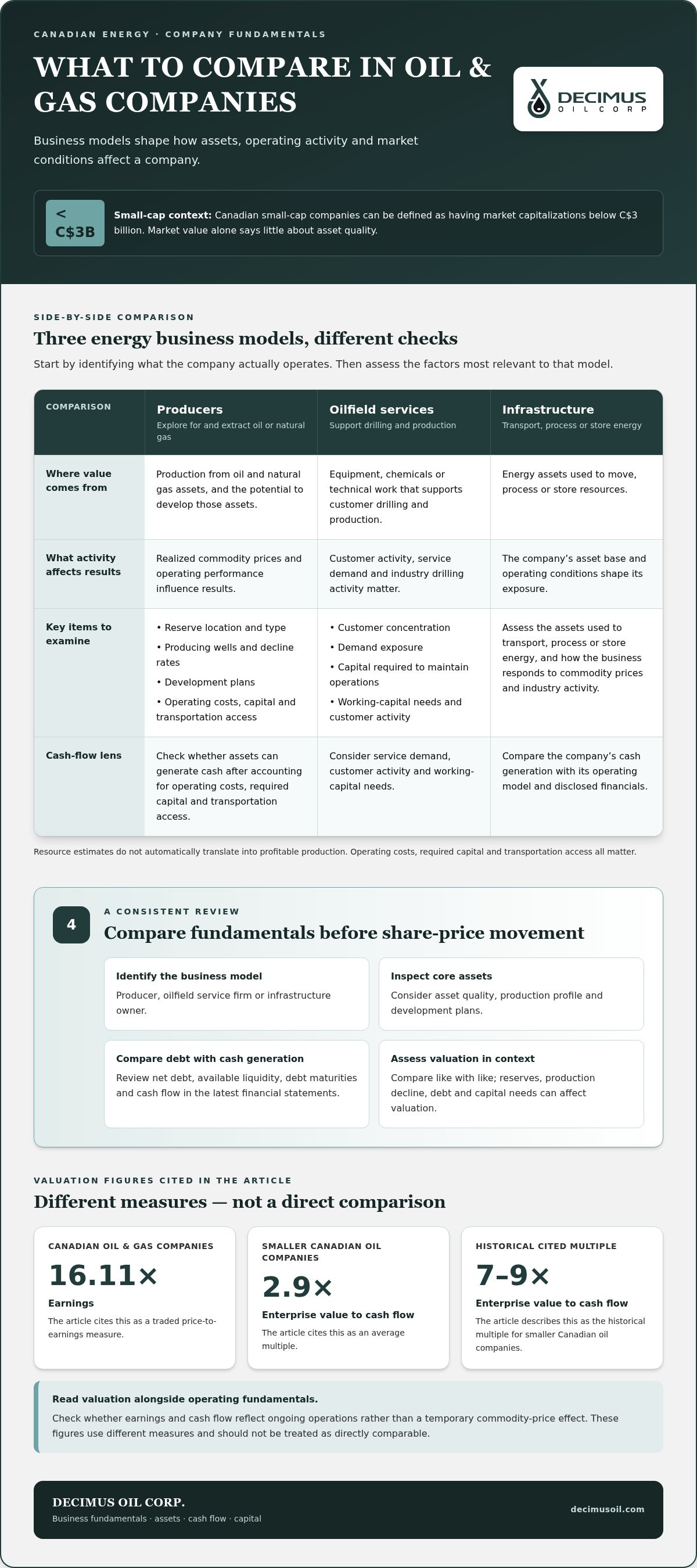
Start by identifying what a Canadian-listed energy company actually operates. Producers explore for and extract oil or natural gas, while oilfield service firms support drilling and production through equipment, chemicals or technical work. Infrastructure owners earn value through assets that transport, process or store energy. These business models respond differently to commodity prices and industry activity. Canadian small-cap stocks can be defined as companies with market capitalizations below C$3 billion, but market value alone says little about asset quality.
For producers, examine reserve location and type, producing wells, decline rates and development plans. Resource estimates do not automatically translate into profitable production: operating costs, required capital and transportation access all affect how assets generate cash. For service companies, assess customer concentration, demand exposure and the capital needed to maintain operations. These checks help distinguish exploration potential from current production or service activity.
There is no fixed ranking of Canadian small-cap oil and gas stocks with the strongest balance sheets and lowest debt. Compare each issuer’s net debt, available liquidity, debt maturities and cash flow in its latest financial statements. Lower debt relative to cash generation generally means more capacity to withstand a downturn.
Valuation metrics add context, but compare like with like. Canadian oil and gas companies traded at 16.11 times earnings, while smaller Canadian oil companies averaged 2.9 times enterprise value to cash flow. The cited historical enterprise-value-to-cash-flow multiple for smaller Canadian oil companies was seven to nine times historical. Differences in reserves, production decline, debt and capital needs can explain why companies receive different valuations. Check whether earnings and cash flow reflect ongoing operations rather than a temporary commodity-price effect.
Use a consistent review across TSX- and TSXV-listed companies: identify the business model, inspect its core assets, compare debt with cash generation, then assess valuation. For an exploration-focused issuer, review how its conventional oil and gas exploration relates to asset development and disclosed operations. This keeps the comparison grounded in business fundamentals rather than share-price movement alone.
4. How to invest in Canadian oil and gas stocks
Begin with a written investment thesis, not a ticker search. Decide whether you want exposure to direct production, oilfield services or infrastructure before comparing Canadian issuers. A producer’s results respond to realized commodity prices and operating performance, while service companies depend more directly on customer spending and drilling activity. This distinction helps align a company’s business model with your strategy.
Next, identify companies through their Canadian exchange listings and review their disclosure. Examine annual and quarterly financial statements, management discussion, production updates, debt information and capital budgets. Compare results with prior periods, noting changes in production, spending priorities and cash generation. Treat company guidance as management’s outlook, not a substitute for reported operating results.
Build a comparison sheet for each issuer. Record its core assets, product mix, production trend, net debt, cash flow and planned capital spending. Then consider whether the valuation reflects current operations or depends heavily on future development. For a small-cap oil and gas stock in Canada, this side-by-side process can reveal differences that a share-price chart alone won’t show.
Test your thesis against market exposure. Canadian producers can be affected by global supply and demand, trade policies and regulation. Consider how changes in commodity prices or customer activity could affect cash generation and the company’s ability to fund its plans. For exporters, assess how transportation access connects production with buyers. For service firms, consider whether customer activity supports demand for their work.
Finally, decide how the investment fits your portfolio and set a review process. A concentrated position increases exposure to one company’s assets, management decisions and operating risks. Diversifying across business models may spread company-specific exposure, but it does not remove sector risk. Revisit your thesis when new disclosures change the outlook instead of reacting to daily share-price movements alone.
The practical sequence is to assess the business model, review filings, evaluate financial resilience and valuation, then consider portfolio fit. This gives investors a repeatable way to assess Canadian energy opportunities and connect each decision to a clear strategy.
4. How do Canadian small-cap oil and gas companies compare by production and reserves?
Compare production and reserves together, rather than treating them as competing measures of strength. Production shows current operating output; reserves represent volumes estimated to be recoverable under defined conditions. A company with higher production may still face faster declines or greater development needs than a peer with lower output.
Start with each company’s latest annual disclosure. Record production by product, such as oil, natural gas and natural gas liquids, then compare the mix and reported trend. A barrel-of-oil-equivalent figure combines different products, which can simplify comparisons while obscuring differences in commodity exposure and realized prices.
Next, assess reserve categories and how the company plans to develop them. Proved and probable reserves represent different levels of confidence, while undeveloped reserves require future investment. Review the reserve report’s assumptions alongside planned wells, operating costs and infrastructure access. A large reserve base has limited value if development cannot generate attractive returns.
Comparing reserve life can add context: relate reported reserves to current annual production, while recognizing that both can change. A longer reserve life does not automatically mean stronger economics. Asset location, decline rates, transportation capacity and the capital needed to sustain output all affect the quality of the position.
For a practical comparison, create a table covering production by product, reserve categories, recent production direction, development spending and infrastructure constraints. Use the same reporting period and units for every company. Then ask whether current production is supported by developed reserves or depends heavily on future drilling. This helps distinguish current operating scale from longer-term potential.
Canadian small-cap producers can differ substantially in product mix, reserve maturity and development plans. Avoid ranking them by one headline figure; connect production trends to reserve quality and the funding needed to convert resources into output. To explore an operator-focused perspective, explore Canadian energy investment.
Decimus Oil: Public Equity Investment (TSXV:WCSB)
Decimus Oil offers public equity investment through its TSXV:WCSB listing for investors considering Canadian energy exposure. Its work in conventional oil and gas exploration, energy infrastructure and enhanced oil recovery connects the investment opportunity with resource development and asset value. These activities may interest investors assessing both a company’s operating focus and its approach to developing hydrocarbon resources.
Consider Decimus Oil when evaluating a publicly traded energy company alongside its business activities. Review its public disclosures and investment information as part of your own assessment of the company, its strategy and the risks of energy-sector exposure.
Visit decimusoil.com to learn more about Decimus Oil.
Build a disciplined investment view
Turn your research into a clear investment thesis. Define what would strengthen or weaken your view, then revisit it as company disclosures and market conditions change. This keeps decisions connected to operating performance rather than short-term share-price movements and gives you a practical way to compare a small-cap oil and gas stock in Canada with other portfolio opportunities.
For investors assessing direct exposure to Canadian energy, Decimus Oil offers public equity investment through TSXV:WCSB, alongside conventional oil and gas exploration and energy infrastructure. These activities connect the investment opportunity with resource development and the assets that support energy operations. Consider how this business focus aligns with your objectives and risk assessment.
Take the next step by reviewing the company’s information and investment opportunity. Contact Decimus Oil to discuss opportunities and continue building an informed perspective on Canadian energy investment.
Frequently Asked Questions
Are Canadian oil and gas stocks a good investment?
A small-cap oil and gas stock may suit investors seeking energy-sector exposure if the risks fit their goals and capacity for volatility. Before investing, decide how much portfolio exposure you can tolerate and what would prompt you to reassess your position. Commodity prices, company performance and market sentiment can shift, so set review criteria before buying rather than relying on a positive outlook alone.
What are the best small-cap oil and gas stocks listed in Canada?
There is no single best choice for every investor. Compare companies using consistent criteria, including debt, cash generation, operating plans and disclosure quality. Investors can assess Canadian energy companies by reviewing their public disclosures and considering how each company fits their objectives. Decimus does not provide investment advice; each investor must decide how an opportunity fits their own objectives.
Which Canadian exchanges list small-cap oil and gas companies?
Canadian energy companies trade on exchanges including the Toronto Stock Exchange (TSX) and TSX Venture Exchange (TSXV). An exchange and ticker identify a listed security, but do not establish a company’s size or investment quality. A ticker can help identify a listed security, but it should be checked against the issuer before trading. Confirm that the ticker matches the issuer before placing an order, as similar company names can cause confusion.
What is the market capitalization and share price of Canadian small-cap oil and gas stocks?
Market capitalization is calculated by multiplying a company’s current share price by its outstanding shares. Canadian small-cap stocks can be defined as companies with market capitalizations under C$3 billion. Share prices change during trading, so use a current quote for the relevant ticker. A share price alone doesn’t show company size: outstanding share counts differ between issuers.
What are analysts' price targets and ratings for Canadian small-cap oil and gas stocks?
Price targets and ratings vary by analyst and depend on assumptions about production, commodity prices, costs, debt and planned development. Coverage also differs between issuers, so targets may not be available for every stock. Read the date, assumptions and risks attached to each estimate, and compare its reasoning with company disclosures. A target is not a promised future price.
How can investors buy Canadian small-cap oil and gas stocks, and what fees apply?
Investors purchase listed shares through a brokerage service provider. Decimus Oil shares must be bought through a brokerage; the company does not sell shares directly or provide investment advice. Brokerage costs depend on the account and transaction and may include trading commissions or account-related charges. Review the applicable fee schedule before placing an order, and consider how trading frequency affects total costs.


