
About 70% of oil produced today comes from mature fields, making decline a planning challenge rather than an automatic signal to stop development. Effective mature oil field development strategies combine reservoir data, infill drilling, recovery options and economic analysis to identify where incremental production may be viable. The right approach depends on what remains in the reservoir and how the field’s wells and infrastructure can support recovery.
When assessing an established asset, it is understandable to focus on declining production. But existing wells, infrastructure and reservoir data can also reveal opportunities to redevelop the field.
This article explains how operators assess infill locations, update reservoir models, compare recovery methods and weigh project economics and risk. It also shows why mature oil field development strategies need to align each incremental decision with the asset’s broader direction.
Key Takeaways
- Use production history alongside geological and seismic mapping to assess whether infill drilling could target remaining reserves effectively.
- Updated reservoir models can help estimate remaining hydrocarbons and compare recovery options, including waterflooding and enhanced oil recovery.
- Evaluate redevelopment against reservoir conditions, infrastructure, development costs, oil prices and uncertainty to understand the project’s incremental economics and risks.
- Align individual well and recovery decisions with the asset’s broader management strategy; Decimus Oil’s public equity investment is listed on the TSX Venture Exchange as TSXV:WCSB.
Infill drilling
Infill drilling adds wells within a producing field to reach reserves that existing wells may not drain. In Canada, the opportunity depends on how reservoir evidence, well placement and completion design work together.
Identifying Infill Drilling Opportunities
Infill opportunities are locations where additional wells could access hydrocarbons left between or beyond existing wells’ drainage areas. Begin by combining historical production data with structural, stratigraphic and seismic mapping. Together, these layers help show how reservoir compartments, producing trends and well performance relate. A detailed geological study is especially valuable when significant reserves may remain: it can distinguish a promising target from an apparent gap caused by incomplete or uneven data.
Compare candidate locations with nearby well histories and the field’s geological interpretation. The goal is to identify a position with a credible path to incremental recovery, not simply to add wells. This focuses drilling on areas where the reservoir evidence supports further development.
Drilling and Completion Options
Infill wells can be vertical or horizontal, depending on reservoir geometry and the target zone. A vertical well can access a selected interval, while a horizontal well can extend through a productive layer. Base the design on the interpreted structure and stratigraphy instead of applying one well type across the field.
Completion choices matter too. A new well can target a specific zone, while recompletion can direct an existing well to another interval. Compare the options against production history and geological evidence to align the wellbore and completion with the intended reservoir target, rather than treating drilling as a stand-alone decision.
How do artificial lift upgrades improve mature-field production? Gas lift injects gas to reduce the weight of the produced-fluid column, lowering bottom-hole pressure and helping fluids reach the surface. It can support production from existing wells without adding an infill well.
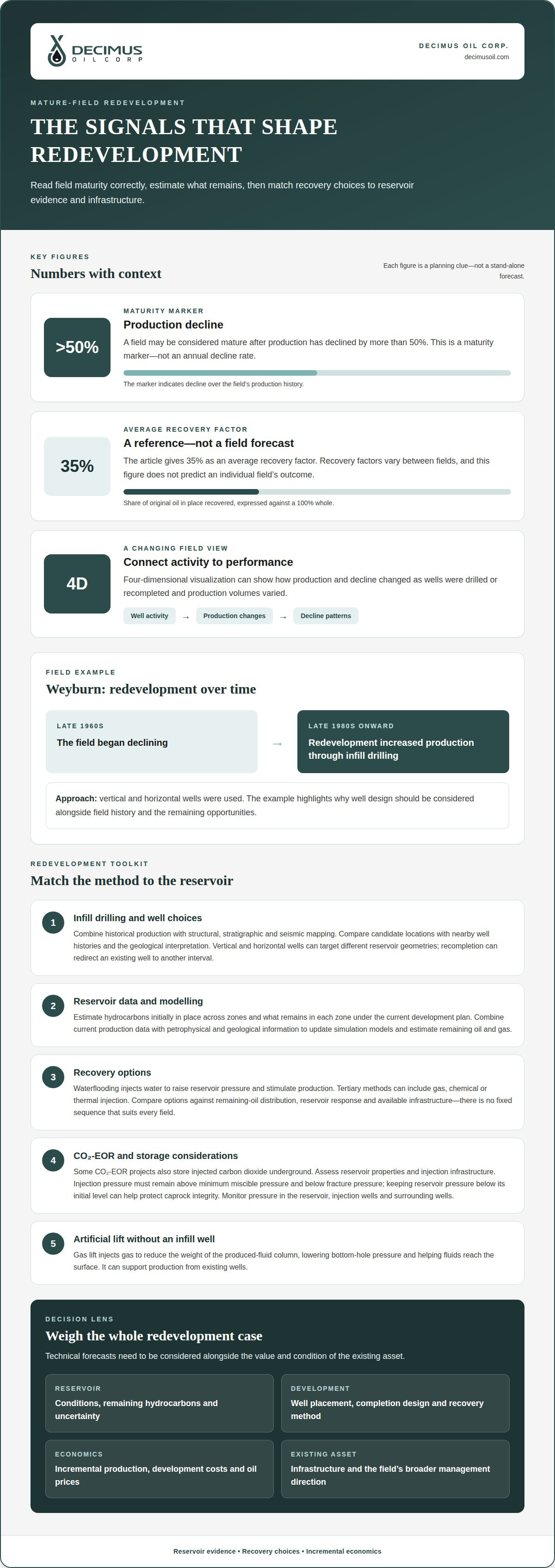
Weyburn illustrates how infill drilling can contribute to redevelopment. The field began declining in the late 1960s, and redevelopment from the late 1980s onward increased production through infill drilling of vertical and horizontal wells. The example shows why operators consider well type alongside field history: redevelopment can combine different well designs to target remaining opportunities. In practice, each proposed location should be assessed against the geological model, nearby well performance and the intended completion. This makes infill drilling part of an integrated recovery plan, not simply an increase in well count.
Reservoir data, modelling options and recovery methods
Redevelopment planning connects reservoir evidence with recovery choices and production objectives. Updated models help operators assess what remains and compare potential interventions.
Reservoir Data and Modelling
An integrated reservoir study estimates hydrocarbons initially in place across all zones and the hydrocarbons remaining in each zone under the current development plan. This distinction matters because field-wide estimates can obscure differences between productive and depleted intervals. Combining current production data with petrophysical and geological information helps update reservoir simulation models and estimate remaining oil and gas.
Four-dimensional visualization can show how production and decline changed as wells were drilled or recompleted and production volumes varied. This timeline helps link performance changes to development activity across the asset.
Enhanced Recovery and CO2 Storage
Enhanced oil recovery can mobilize additional oil, and some CO₂-EOR projects also store injected carbon dioxide underground. Field infrastructure and reservoir properties help determine whether this approach fits the redevelopment plan. Injection pressure must remain above minimum miscible pressure and below fracture pressure. Keeping reservoir pressure below its initial level can help protect caprock integrity.
Planning also requires assessing the geology and preparing infrastructure for injection. Monitoring pressure in the reservoir, injection wells and surrounding wells during operations helps reduce the risk of unintended fluid movement.
Integrated and Tertiary Recovery
Integrated improved oil recovery coordinates reservoir and well interventions within a field-wide plan. Tertiary methods can include gas, chemical or thermal injection, while waterflooding injects water to raise reservoir pressure and stimulate production.
Compare methods based on remaining oil distribution, reservoir response and infrastructure. Water’s low cost and ready availability help explain its use in waterflooding. Gas, chemical and thermal injection suit different conditions, so choose an approach that fits the reservoir rather than following a fixed sequence.
Decline Rates and Recovery Factors
There is no single annual decline rate that applies to every mature oil field. A field may be considered mature after production has declined by more than 50%, but this is a maturity marker, not an annual rate. Recovery factors describe the share of original oil in place that has been recovered, and they can vary between fields.
What production decline rates and recovery factors are typical for mature oil fields? The 35% figure is an average recovery factor, not a forecast for an individual field. Decline varies with reservoir conditions and development history.
Economic and risk considerations in redevelopment
Redevelopment decisions depend on incremental production, project costs, reservoir uncertainty and the value of existing infrastructure. In Canada, economic analysis should connect technical forecasts with the approvals and operating conditions relevant to each project.
Incremental Economics and Risk Analysis
Incremental project economics compare the expected value of a proposed redevelopment with the extra investment and operating demands it creates. This matters because mature-field projects are often limited in scope and economically marginal. Reservoir simulation and economic assessment can test different development scenarios, while realistic uncertainty ranges make assumptions visible. A field pilot can demonstrate feasibility when modelling alone leaves important questions unresolved.
Assess the proposed activity based on its own production contribution, not the field’s existing output. For example, compare a new well or recovery intervention with the production profile expected without that change. Examine how reservoir conditions, oil prices and development costs affect the incremental case. This shows decision-makers which assumptions matter most and where technical risk could change project value.
Economic and Regulatory Factors
Redevelopment economics reflect reservoir conditions, oil prices, development costs, pipeline infrastructure and regulatory frameworks. Existing wellbores, surface infrastructure and government approvals can support redevelopment and improve incremental-recovery economics. Their value depends on how well they suit the proposed activity: available capacity, asset condition and the approval pathway all shape their contribution.
Review these factors together, not as separate checklist items. A development concept may be technically attractive, but its economics can change if pipeline access is constrained or infrastructure needs modification. Regulatory requirements also shape project timing and execution in Canada, so include applicable approvals in the development plan and economic assessment. This helps distinguish a technically possible project from one that fits the asset’s commercial and operating objectives.
Finally, compare the redevelopment proposal with the asset’s broader management strategy. Mature-asset choices can range from harvesting production to divestment, and incremental activities should support the chosen direction. A pilot may suit a project whose feasibility needs to be demonstrated; a larger commitment may depend on the modelled case, risk range and infrastructure fit. This disciplined comparison keeps technical potential, regulatory considerations and commercial objectives connected throughout planning.
Mature-field challenges and management strategies
Mature petroleum assets can combine long operating histories with declining production, ageing equipment and remaining resource potential. Some fields operate for 30 to 100 years, making management decisions relevant across extended asset lifecycles. The central challenge is aligning each intervention with the field’s technical condition and the operator’s long-term objectives.
How do operators compare brownfield redevelopment with new oil field development? They compare incremental production, technical uncertainty, infrastructure needs, approvals and project risks. Existing wellbores and surface facilities may support redevelopment, while a new field needs a different development plan. Using consistent assumptions helps clarify which option better fits the operator’s objectives.
The management strategy also determines which activities merit attention. An operator may harvest an asset, pursue selected incremental projects or divest it; individual activities should support that direction. For example, temporarily idling one well may increase production from nearby wells, while a new injection site may strengthen an existing waterflood. Recompletion or fracture treatments are other options, but each should fit the asset’s reservoir and operating priorities. Assess interventions as parts of an overall management plan, not as isolated opportunities.
What are the environmental and operational risks of developing mature oil fields? Well integrity concerns, pressure changes and ageing infrastructure can create environmental and operating risks. Planning should account for the condition of existing wells and facilities, as well as how proposed activities could affect nearby operations. Monitoring and maintenance help operators manage these issues as development proceeds.
Established infrastructure can be an advantage, but it also creates interdependencies: changes to one well or facility may affect other producing assets. A field-wide view helps identify these connections and align production decisions with operating constraints. Regularly reviewing the asset strategy against performance and remaining opportunities also keeps incremental activity focused on its intended outcome.
Explore how Decimus Oil approaches resource development as you consider the direction of your asset.
Decimus Oil Corp.: Public Equity Investment (TSXV:WCSB)
Decimus Oil Corp. offers public equity investment through TSXV:WCSB for readers considering exposure to Canada’s energy sector. Its activities include conventional oil and gas exploration, energy infrastructure, resource development and enhanced oil recovery. These areas connect with redevelopment planning: exploration and resource development focus on hydrocarbon assets, while enhanced oil recovery can increase production from existing reservoirs.
Investors can consider the company as a publicly traded energy business alongside the technical and economic factors that shape mature-field decisions. Review the company’s focus and your own investment objectives to assess whether this opportunity aligns with your approach.
Visit decimusoil.com to learn more about Decimus Oil Corp.
Turn redevelopment insight into a clear plan
The next decision is how to turn a field’s technical potential into a focused development plan. Mature oil field development strategies work best when each proposed activity has a defined role, a clear connection to the asset’s direction and a way to evaluate progress. This discipline helps teams prioritize opportunities while aligning operational and investment decisions.
For Canadian energy stakeholders, the broader question is how redevelopment fits within a changing portfolio and long-term resource priorities. A deliberate discussion can clarify where development goals, infrastructure considerations and recovery planning intersect. Decimus Oil’s focus in the energy sector offers a relevant starting point for that discussion.
Discuss your development priorities with Decimus Oil and take the next step toward a considered plan. With a clear direction, redevelopment decisions can support purposeful progress.
Frequently Asked Questions
What are the main development strategies for mature oil fields?
Key options include infill drilling, recompleting existing wells, artificial lift, waterflood adjustments and enhanced recovery. Practical mature oil field development strategies match each intervention to the asset’s production goals and remaining reservoir potential. For example, a well producing from a depleted interval may be a candidate for recompletion, while a field-wide recovery change calls for a broader technical and economic assessment.
How can enhanced oil recovery extend production in mature oil fields?
Enhanced oil recovery can mobilize oil left behind by earlier production methods, extending a field’s productive life when reservoir conditions support the method. Operators compare injection options, such as gas, chemical or thermal methods, based on expected incremental recovery, cost and recovery time. The choice should reflect the field’s properties and existing infrastructure: a technically suitable method must also fit the operating context.
When are infill drilling and well recompletions economically viable?
These options are viable when expected incremental production supports the added drilling or workover, completion and operating demands. Infill drilling may fit where geological interpretation indicates an undrained target; recompletion may be more compelling when an existing well can access another productive interval. Compare each option with the field’s expected production without the intervention, and include uncertainty in the forecast before selecting a development case.
How do operators optimize waterflooding and injection patterns in aging fields?
Operators use injection and production performance to assess whether water is supporting recovery across the intended reservoir areas. If parts of the field respond unevenly, a revised injection pattern or new injection site may strengthen the waterflood. The analysis should account for reservoir behaviour and pressure response, then compare the revised pattern with production outcomes to determine whether it improves the recovery plan.
What are the costs and economics of mature oil field redevelopment in Canada?
Redevelopment costs depend on the required work, including well interventions, new drilling, facility changes, pipeline access and the selected recovery method. The economic case compares these outlays and ongoing operating needs with incremental production over the project’s expected life. Oil prices, reservoir performance and infrastructure capacity also affect value, so no single cost figure represents every Canadian field or redevelopment concept.
How do Canadian royalties, regulations, and abandonment rules affect mature oil field development?
These factors affect project cash flow, timing and end-of-life planning, so include them in the economic assessment alongside production and operating assumptions. For a Canadian project, model applicable royalty terms, approval requirements and closure liabilities as distinct planning inputs. Their effects depend on the jurisdiction, project design and production profile. Assessing them early shows how fiscal and end-of-life considerations influence redevelopment choices.


