
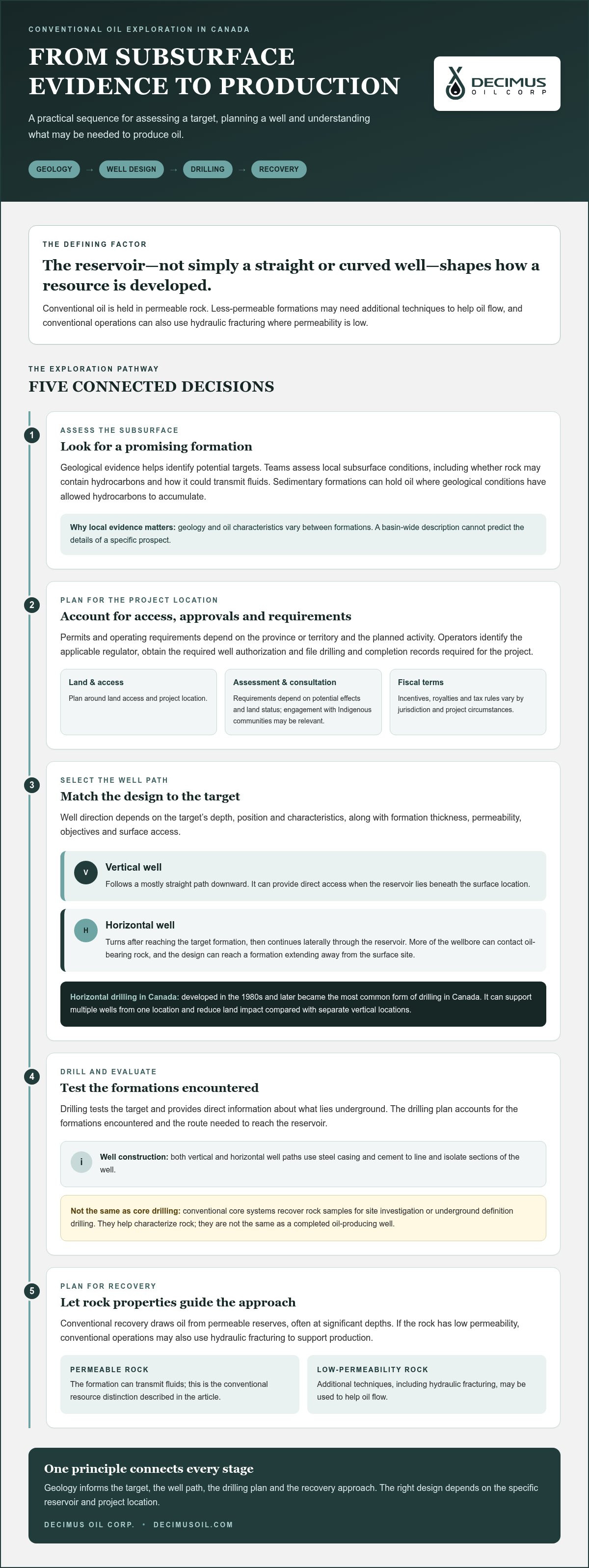
The decisive difference is the reservoir, not simply whether a well runs vertically or horizontally. Conventional drilling exploration in Canada targets oil held in permeable rock, while unconventional resources are typically held in less-permeable formations and may need additional techniques to flow. Conventional wells can also require hydraulic fracturing when the rock has low permeability.
It’s easy to associate conventional oil with a straight vertical well, but geology and well design determine how a resource is developed. This article explains conventional drilling exploration in Canada, how conventional and unconventional oil differ, and what those differences mean for exploration and production.
You’ll learn where onshore conventional oil is found and how vertical and horizontal wells reach underground reservoirs. We follow the process from identifying a potential resource to choosing a drilling approach, showing how geology, well design and recovery methods fit together.
Key Takeaways
- Distinguish conventional oil in permeable rock from unconventional resources, which may need additional techniques to flow.
- Compare vertical and horizontal well designs by how they reach the reservoir and how a drilling plan can affect land use.
- Use the Western Canadian Sedimentary Basin’s varied geology to understand why exploration and recovery approaches differ between locations.
- Follow the exploration and drilling stages to see how resource assessment leads to well planning, drilling and production.
Where is Canada’s onshore conventional oil?
Canada’s onshore conventional oil occurs in sedimentary rock formations where geological conditions have allowed hydrocarbons to accumulate. A formation’s ability to transmit fluids influences how operators assess a prospect and plan a well. Conventional operations in low-permeability rock may also use hydraulic fracturing to support production.
Onshore resources vary across the country. Oil characteristics and subsurface geology differ by formation, shaping how operators assess potential targets. Exploration uses geological evidence to identify promising areas; drilling then tests those formations and provides direct information about what lies underground.
Permits and regulations depend on the province or territory where a proposed well is located. There is no single permit list for every Canadian jurisdiction. The location and planned activity determine which approvals and operating requirements apply.
Exploration wells are licensed under the applicable jurisdiction’s rules, with reporting requirements tied to the work performed. Operators identify the relevant regulator, obtain the required well authorization, and file the drilling and completion records required for the project.
Environmental assessment and consultation requirements depend on a project’s location, potential effects and land status. Planning also considers land access and, where relevant, engagement with Indigenous communities.
Incentives, royalties and tax rules vary by jurisdiction and project circumstances. Operators consider applicable fiscal terms alongside the resource type, expected production and development plan.
The cost to explore and drill a conventional well depends on the case and is provided after a quote request. Depth, access, geology and the drilling program shape the estimate.
Canadian exploration statistics depend on what is being measured. Wells drilled, wells completed and producing wells describe different kinds of activity, so comparisons are meaningful only when they use the same period and category.
Key risks include drilling hazards, environmental effects and financial uncertainty. Unexpected geology can change a well plan, while spills or equipment incidents can affect people, land and project economics.
Vertical and horizontal drilling
A vertical well follows a mostly straight path downward through rock layers to reach a target reservoir. Operators use geological information to select the target, then drill and evaluate the formations encountered. If the reservoir lies beneath the surface location, a vertical well can provide direct access. Its suitability depends on the target’s depth, position and characteristics.
Horizontal drilling changes direction after the well reaches the target formation. The wellbore curves and continues laterally through the reservoir, placing more of its length in contact with oil-bearing rock. This approach can help access a formation that extends away from the surface site. In Canada, horizontal drilling can also support multiple wells from one location and reduce land impact compared with separate vertical locations.
Horizontal drilling was developed in the 1980s and later became the most common form of drilling in Canada. The method is not automatically right for every reservoir. Geology, formation thickness, permeability, well objectives and surface access all inform the design. In low-permeability rock, conventional oil operations may also require hydraulic fracturing to support production.
Both well paths use steel casing and cement to line and isolate sections of the well. Conventional recovery draws oil from permeable reserves, often at significant depths. The drilling plan must account for the formations encountered and the route to the reservoir. A vertical trajectory may suit a target directly beneath the site; a horizontal trajectory can follow a productive interval laterally.
“Core drilling” can mean something different from drilling an oil well. Conventional core systems recover rock samples for shallow site investigations or underground definition drilling. In those systems, crews pull the entire drill string from the hole to collect core. This process helps characterize rock; it is not the same as producing oil through a completed well.
For conventional drilling exploration in Canada, compare how each well path reaches the target and interacts with the reservoir. Operators weigh subsurface evidence, production objectives and land footprint together. The resulting design connects geology with access, well construction and recovery strategy.
Western Canadian Sedimentary Basin
The Western Canadian Sedimentary Basin spans four provinces and supports conventional oil and natural gas production. Its geology varies across the basin, so formations and recovery conditions differ between wells. Basin-wide descriptions provide useful context, but they cannot predict a specific prospect. Exploration teams assess local subsurface evidence before selecting a drilling target and planning how to evaluate it.
Geological variation shapes the questions operators ask at each stage. They assess whether a formation may contain hydrocarbons, how its rock could transmit fluids and what well design could test it. A discovery in one formation does not establish the characteristics of another. Comparing geological records and drilling results helps build a clearer understanding of the basin’s distinct targets.
Crude oil itself also varies. The Canadian Fuels Association states that more than 150 different types of oil exist worldwide. Most crude oil has an API gravity between 20 and 45. API gravity describes oil density relative to water, giving operators and market participants a useful way to characterize crude.
Heavy crude has an API gravity below 22.3, while light crude has an API gravity greater than 31. Western Canada Select typically ranges from 19 to 22 API gravity. These figures illustrate that crude characteristics can differ substantially; they do not describe every resource or well across the basin.
Exploration decisions connect basin-scale context with well-specific evidence. Teams identify a geological target, plan a well to test it, and assess the formations and fluids encountered. Production potential depends on the reservoir’s properties and the evaluation results. Across a basin spanning four provinces, this location-specific approach distinguishes broad geological trends from the evidence needed to guide an individual development plan.
What are the stages of conventional oil and gas exploration and drilling?
Conventional exploration progresses from geological assessment to drilling and, where a well can produce, development. Each stage reduces uncertainty: teams use subsurface evidence to select a target, then evaluate what the well encounters. The sequence connects geology, well design and production decisions instead of treating drilling as an isolated activity.
- Assess the subsurface. Geologists interpret existing geological information to identify formations that may contain oil or natural gas. They consider the structure and properties of the rock before selecting a potential target.
- Select a prospect. The team defines a target area and plans how a well could test it. The formation’s depth, position and expected characteristics inform the proposed well path.
- Prepare the site and well plan. Access, surface layout and the drilling program are coordinated before operations begin. The planned trajectory and equipment must suit the target and anticipated formations.
- Drill and evaluate. The rig advances the well through underground layers. Geological observations and well data help determine whether the target contains hydrocarbons and can support further development.
- Complete and produce. If evaluation supports production, the well is prepared to bring oil or gas to the surface. Conventional recovery uses steel casing and cement, with production from permeable reserves, often at significant depths.
These stages inform one another. If drilling encounters different rock conditions than expected, the team can use that evidence to refine its understanding and future plans. A discovery also needs evaluation: identifying hydrocarbons alone does not establish how a reservoir will perform or how it should be developed.
Production decisions draw on well results and reservoir characteristics. Operators consider how fluids move through the rock, the well’s construction and the infrastructure needed to manage output. This is where exploration findings inform practical development choices, including whether additional wells or recovery planning are warranted.
To see how exploration connects with resource development, explore Canadian resource development.
Decimus Oil: Public Equity Investment (TSXV:WCSB)
Decimus Oil connects the geology and development process discussed above with public equity investment in Canada’s energy sector. Its shares trade on the TSX Venture Exchange as TSXV:WCSB, giving investors a publicly traded way to participate in the sector.
The company focuses on conventional oil and gas exploration, energy infrastructure, resource development and enhanced oil recovery. These activities span different stages of developing hydrocarbon resources, from exploration to infrastructure and recovery. Readers evaluating conventional drilling exploration in Canada can use this context to understand how an energy company’s activities may extend beyond drilling.
Consider Decimus Oil if you want to learn about its conventional resource development or public equity investment. Public equity carries investment risk, and the company’s business activities do not guarantee investment performance. Shares must be purchased through a brokerage service provider.
For more information, visit decimusoil.com.
Turn geological understanding into a considered next step
When evaluating conventional drilling exploration in Canada, consider how geological evidence aligns with a project’s objectives and investment priorities. Look beyond a promising target to assess how exploration, development planning and infrastructure connect. A disciplined review helps clarify the questions to answer before advancing a resource opportunity.
Decimus Oil offers a way to learn about conventional exploration, resource development and the broader energy sector. To discuss the company’s activities, contact Investor Relations at [email protected]. Shares are purchased through a brokerage service provider, and Decimus Oil does not provide investment advice.
Contact Decimus Oil to discuss your project and take the next step with greater clarity.
Frequently Asked Questions
Conventional, unconventional, what’s the difference?
The key distinction is how readily oil or gas can move through reservoir rock. Conventional resources occur in permeable formations that can transmit fluids to a well; unconventional resources are generally held in tighter rock and may need additional stimulation. For example, low permeability can mean hydraulic fracturing is used in a conventional operation. Resource type and well technique are not interchangeable labels.
What is conventional oil and gas drilling exploration in Canada?
Conventional exploration identifies a potential oil or gas reservoir, tests it with a well and assesses whether production is feasible. Exploration investigates what lies underground; drilling provides direct evidence from the formations encountered. If the well can produce, operators plan how to complete and manage it. In Canada, the specific geology and applicable provincial or territorial requirements shape the project.
Where are Canada's main conventional oil and gas exploration regions?
The Western Canadian Sedimentary Basin is a principal onshore region, spanning four western provinces. Distinct settings include northeastern British Columbia, where ultra-light condensate is often recovered, and the Lloydminster area near the Alberta-Saskatchewan border, associated with heavy oil. These examples show why regional exploration is not one uniform play: fluid and subsurface conditions can change from one location to another.
How does conventional drilling differ from unconventional drilling in Canada?
The difference lies mainly in the reservoir and how it yields hydrocarbons, not simply in whether the well is vertical or horizontal. Conventional drilling targets permeable reserves, while unconventional development targets tighter formations and may require additional stimulation. A horizontal well can be used in either context; its trajectory describes how the bore moves through rock. Operators assess both the formation and the well design when comparing approaches.
What permits and regulations apply to conventional drilling in each Canadian province and territory?
Permits and regulations depend on the province or territory, the well’s location and the planned activity. Operators identify the relevant regulator, obtain the required well authorization, and file drilling and completion records under that jurisdiction’s rules.


