

The right to develop oil and natural gas follows the mineral rights, not simply ownership of the land above them. In oil and gas lease development in Canada, provincial Crowns generally grant mineral rights through licences for exploration and leases for production, while some rights are privately held. The area included in a lease also matters: its boundaries can determine which lands are retained and which must be surrendered.
Securing a mineral rights lease is only one part of oil and gas lease development in Canada. Surface access, compensation and regulatory requirements shape how work proceeds, while lease terms define the rights and obligations attached to the lands.
This guide explains who may explore, drill and produce, how surface access and compensation are handled, and which fees and documents may apply. It also covers lease-block dimensions and what may happen to permit lands left outside a lease, helping you assess the rights, costs and land decisions involved.
Key Takeaways
- Identify who holds the mineral rights before assessing who can explore, drill, or produce beneath a property.
- Separate mineral rights from surface access, and understand what a surface agreement can cover.
- Review lease rentals, payment timing, and required submissions as part of evaluating the full commitment.
- Assess lease block dimensions and determine how permit lands outside the lease area may be handled.
Lessee rights to explore, drill, and produce
A lessee holds rights to the minerals covered by a lease, subject to its terms and required approvals. Those rights are shaped by development and drilling obligations, as well as the lands included.
Drilling and Spacing Requirements
Drilling and spacing requirements govern where wells may be drilled and how development is organized. In Alberta, an oil-production drilling unit normally consists of forty acres. If a well in a permit area is ordered to contain oil or gas in commercial quantity, another well cannot be drilled within 4 1/2 miles while no lease application has been made pursuant to section 66. This restriction limits competing drilling near the discovery.
Development Drilling Obligations
Development drilling obligations require a rights holder to advance exploration and production under the applicable lease or order. A company must act to explore and develop oil or natural gas during its mineral rights lease; otherwise, the mineral rights revert to the provincial government. A common Canadian lease offset clause requires drilling within ninety days after production in paying or commercial quantities is developed on adjoining lands. When ordered by the Minister, a lessee must commence and continue drilling a well on Canada lands to the Minister’s satisfaction within 90 days of the order, except during the three years following lease issuance.
Permits and Environmental Assessments
Permits and environmental assessments are approvals and reviews that apply to proposed drilling and operations. Alberta’s Oil and Gas Conservation Act, R.S.A. 2000, c. O-6, provides licensing and approval requirements for drilling and operating facilities, and regulates oil field and pool development. Alberta’s Environmental Protection and Enhancement Act, R.S.A. 2000, c. E-12, addresses environmental assessments, hazardous substances, and contaminated-land remediation.
For Indigenous communities, consultation and engagement processes depend on land status and the approvals involved. Exploration on Indian lands is governed by the Indian Oil and Gas Act, R.S.C. 1984 c. I-7, and the Indian Oil and Gas Regulations, 1995, S.O.R./94-753.
Lease risks can include continuing reclamation and contamination liabilities. In Alberta, licensees and non-licensee owners of oil and gas facilities remain liable for surface reclamation issues for 25 years after termination of the applicable drilling licence, and permanently liable for contamination issues.
Surface access and compensation
Surface rights govern access to the land above oil and gas resources and are separate from mineral rights. After obtaining a mineral lease, a company must arrange surface access with the landowner before beginning operations.
Surface Access Agreements
A surface access agreement sets the terms for using land to explore or develop oil and gas resources. It typically describes proposed activities, above-ground structures, compensation and a survey plan showing the lease area and planned well and infrastructure locations. Reviewing the plan alongside the proposed work helps clarify which areas are covered and how operations may affect the surface.
Access to Land
Land access is the permission or legal arrangement that allows a company to reach and use the surface for resource operations. Surface ownership may belong to farmers, other property owners, municipalities or the Crown. The appropriate agreement and process depend on the owner and location of the proposed work. Canada lands include areas where the federal Crown owns mineral rights, such as national parks, Indian reserves and offshore lands. Surface access arrangements must respect ownership and applicable rules.
Federal and Provincial Rules
Federal and provincial rules govern different lands and aspects of oil and gas access. In Alberta, the Surface Rights Act, R.S.A. 2000, c. S-24, establishes the Surface Rights Board and sets rules for obtaining land access rights to exploit oil and gas. The relevant framework depends on the land’s jurisdiction and ownership. For a project, identify the landholder and location first, then determine which surface-access process applies. A mineral lease alone does not replace the arrangements needed to use the surface.
Lease application fees, rentals, and required documents
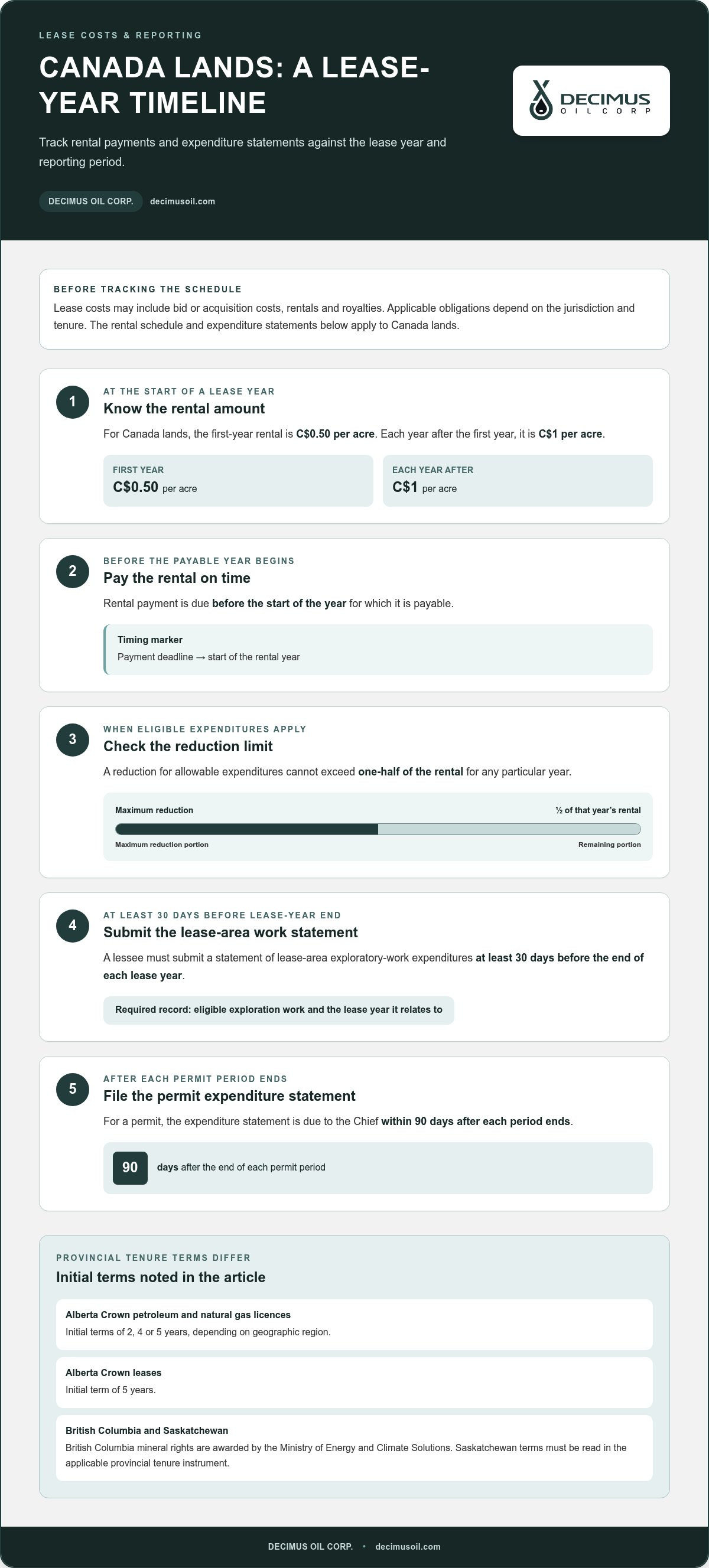
Lease costs may include bid or acquisition costs, rentals and royalties. The applicable obligations depend on the jurisdiction and tenure. For Canada lands, track the rental schedule and expenditure statements.
Provincial lease terms differ by jurisdiction and instrument. In Alberta, Crown petroleum and natural gas licences have initial terms of 2, 4, or 5 years, depending on geographic region; Crown leases have an initial term of 5 years. British Columbia mineral rights are awarded by the Ministry of Energy and Climate Solutions. Saskatchewan terms must be read in the applicable provincial tenure instrument.
Lease Rentals and Reductions
A rental is a recurring payment for lands held under a lease. On Canada lands, the first-year rental is C$0.50 per acre, then C$1 per acre each year after the first year. Payment is due before the start of the year for which it is payable. A reduction for allowable expenditures cannot exceed one-half of the rental for any particular year.
Keep a record of eligible exploration work and the lease year to which it relates. A lessee must submit a statement of lease-area exploratory-work expenditures at least 30 days before the end of each lease year. For a permit, the expenditure statement is due to the Chief within 90 days after each period ends.
Bonuses, Delay Rentals, and Tax Treatment
A bonus is an acquisition payment for a lease interest, while delay rental payments keep the interest in force without drilling. Under the Canadian tax treatment described here, delay rentals are taxable to the lessor when received. Bonus or lease-acquisition costs are capital expenditures for the lessee and capital accretions for the lessor.
The stated deduction treatment allows delay drilling rentals up to C$1 per acre per year. Section 53(2)(a) of the Income Tax Act is identified for lessees claiming bonus-cost deductions within the available one-dollar-per-acre allowance. Crown terms are often established by provincial regulations; freehold lease terms are generally set out in the document, making negotiation before execution important.
Lease block dimensions and retained permit lands
A lease block is a defined parcel of mineral rights included in an oil and gas lease. In Canada, lease areas are generally arranged as quadrilateral blocks no larger than five sections by three sections or four sections by four sections. These dimensions define the minerals and potential natural gas development covered by the lease.
A special block limit applies when a lease covers no more than two-fifths of the sections in an applicant’s permit area. In that case, the lease area may consist of quadrilateral blocks up to six sections by three sections. Since this differs from the general dimensions, identify the applicable regulatory condition before mapping lands for development.
Retained permit lands are the portions of a permit area that remain outside the lease granted from it. Under section 54, a lease generally requires the permittee to surrender to the Crown permit-area land not included in the lease. The Minister cannot grant a lease for more than one-half of the sections in the applicant’s permit area. Plan for excluded acreage when evaluating the long-term value of a discovery or potential production.
Grouped permit areas are separate permit lands treated together for specified regulatory purposes. Their combined area cannot exceed 2,500,000 acres, and any parts must be within 100 miles of one another or contiguous. These boundaries affect how a permit holder organizes acreage, not just the shape of one lease block.
Before applying, compare the permit map with the proposed lease outline and note which sections will be included or surrendered. Separate block geometry from ownership and royalty obligations: the lease area defines the land interest granted, while the applicable terms and regulations govern its use. This mapping step clarifies what acreage remains available after a lease is issued.
For a closer look at resource development, explore how land interests and project planning connect.
Decimus Oil: Public Equity Investment (TSXV:WCSB)
Decimus Oil Corp. connects the lease-development discussion to conventional exploration and public equity investment in the energy sector. Its TSXV:WCSB offering may be relevant to readers considering public-market exposure, while its resource development activities relate to advancing hydrocarbon assets.
Decimus Oil Corp. is also publicly traded on the TSX Venture Exchange as WCSB. Shares are generally bought through brokerage services. The company does not provide investment advice or act as a financial advisor, so assess public-market investments separately from the specific terms and obligations of an individual lease.
For information about Decimus Oil Corp. and its public equity investment, visit decimusoil.com.
Move from lease review to strategic planning
Connect land decisions with the broader objectives of a project. When assessing oil and gas lease development in Canada, consider how the lease position supports resource development plans, capital allocation and long-term value. Viewing these decisions as part of one strategy can help clarify which opportunities to examine next.
Decimus Oil Corp.’s focus on exploration and resource development provides context for readers considering energy development. Explore the company’s public information to understand its business, and assess any investment opportunity separately from the general guidance in this article.
Contact Decimus Oil Corp. to continue the discussion. A thoughtful next step can turn a complex land and development picture into a clearer basis for planning.
Frequently Asked Questions
Who has the right to develop Canada’s oil and natural gas resources?
The holder of mineral rights can authorize exploration and production, subject to applicable permits and lease terms. Provincial Crowns hold most mineral rights, while freehold rights are privately held. The federal Crown holds mineral rights on federal lands, including national parks, Indian reserves and offshore areas. Canada has no national oil company; provincial ministries grant Crown mineral rights to companies and other eligible entities.
How does oil and gas lease development work in Canada?
Development moves from securing mineral rights to planning and conducting authorized work. A company assesses the lease area, arranges surface access, and obtains the approvals that apply to its proposed operations. Written notice is generally required at least 15 days before exploratory work begins; for areas wholly or partly covered by seacoast waters, notice is required at least 45 days beforehand. Production follows successful development and regulatory approvals.
What are the steps to acquire an oil and gas lease in Canada?
Start by identifying the land jurisdiction and the rights being offered, then review the tender or application process and the proposed lease area. For a section 57 tender, the tender must be advertised at least 30 days before closing. Under the specified ownership test, an individual applicant must be a Canadian citizen over 21, while at least 50 per cent of a corporation’s issued shares must be beneficially owned by qualifying Canadian citizens or corporations.
What are typical oil and gas lease bonuses, rentals, and royalty rates in Canada?
Bonus amounts depend on how rights are offered and the lease terms, while Canada lands rentals are set by regulation. The first-year rental is C$0.50 per acre, followed by C$1 per acre each year after the first. For qualifying Canada lands, the initial monthly royalty is 5% of market value, then 10% after the applicable initial period. Location and the lease’s royalty provisions determine which schedule applies.
How are Canadian oil and gas rights leased on Crown land versus private land?
Crown rights are generally obtained through a provincial or federal process, with terms commonly set by regulation. Freehold rights are leased from private mineral owners, and the lease document generally sets the terms, making negotiation important before signing. Alberta illustrates the distinction: Crown petroleum and natural gas leases have an initial term of 5 years, while freehold terms depend on the executed agreement.
What are the timelines and costs for drilling and developing an oil and gas lease in Canada?
Timing and project costs depend on the lease, planned work, land access, and required approvals. A drilling order on Canada lands generally requires the lessee to start and continue drilling within 90 days, except during the three years following lease issuance. Budget planning should account for applicable rentals, lease acquisition costs, surface compensation, and project-specific drilling and infrastructure work. Exploratory-work notice periods also affect scheduling.


