
Conventional oil production in Canada is not a legacy sector nearing its end; it's a high-tech, low-decline engine for strategic energy growth that continues to outperform expectations. Many investors and industry professionals struggle to distinguish between the high-cost complexities of oil sands and the streamlined efficiency of traditional reservoirs. You've likely noticed that while unconventional plays grab the headlines, the challenge of assessing the economic viability of mature fields remains a significant barrier for those seeking stable value.
This reference guide offers a clear path through the noise. You'll gain a comprehensive understanding of the geology, economics, and modern technologies driving conventional oil production across Canada. We'll examine the unique geological advantages of the Western Canadian Sedimentary Basin and demonstrate how sophisticated operators use enhanced oil recovery and infrastructure optimization to maximize asset value. By the end of this guide, you'll realize how junior producers are leveraging these proven resources to create substantial growth in a shifting energy market.
Key Takeaways
- Contrast traditional extraction with oil sands to clarify the technical and operational differences that define modern resource plays.
- Uncover how the "stacked pay" zones within the WCSB maximize the efficiency of conventional oil production Canada by accessing multiple formations from a single site.
- Analyze the economic benefits of low-decline assets that offer predictable cash flow without the extreme capital requirements of mining mega-projects.
- See how enhanced oil recovery and high-intensity completions are used to optimize existing infrastructure and extend the life of mature reservoirs.
- Evaluate the agility of junior energy firms and their unique ability to realize value through strategic asset revitalization and disciplined resource development.
Defining Conventional Oil Production in the Canadian Context
Conventional oil production Canada remains a cornerstone of the national economy; it provides a stable and efficient source of energy that differs significantly from the labour-intensive oil sands. At its core, the technical definition of conventional oil refers to liquid hydrocarbons trapped within naturally porous and permeable rock formations, such as sandstone or carbonate. These reservoirs allow the oil to flow toward a wellbore under natural pressure or via standard mechanical pumping. This sector's historical significance can't be overstated. It was the foundation upon which Canada's reputation as a global energy powerhouse was built, long before the large-scale development of unconventional bitumen resources became the primary focus of national headlines.
Conventional vs. Unconventional: A Technical Distinction
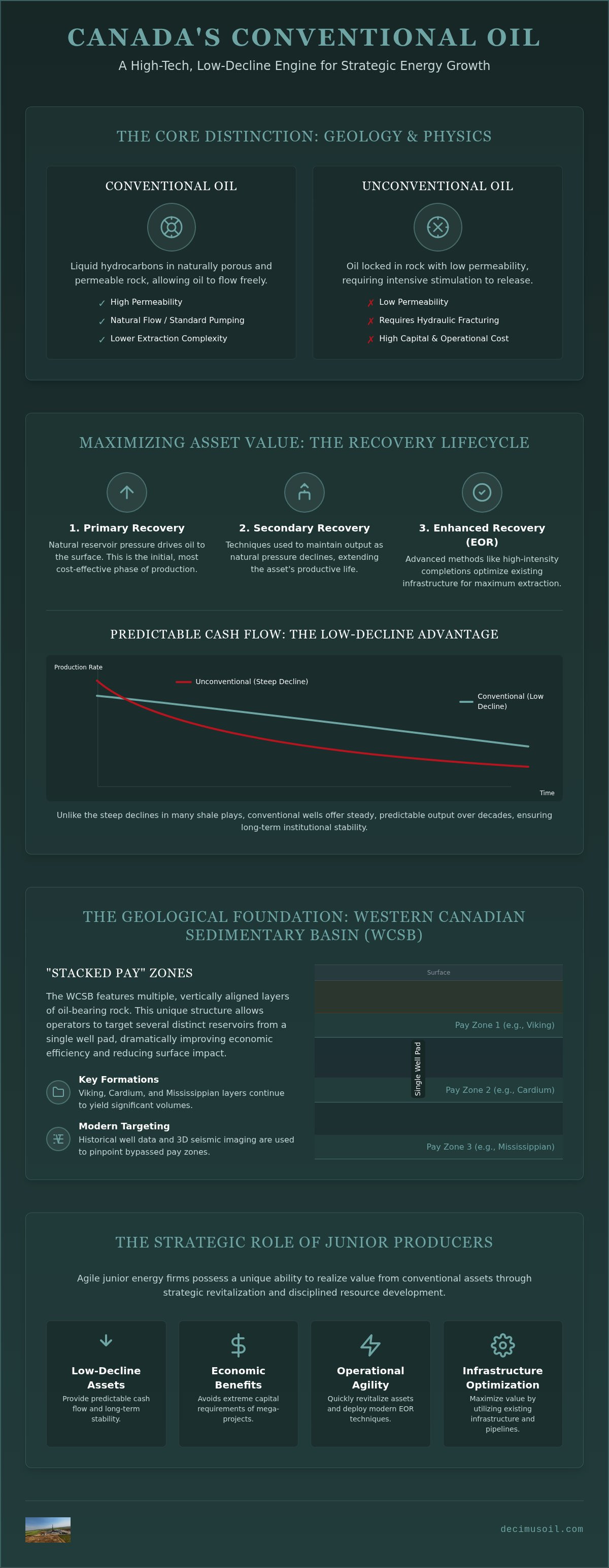
The distinction between conventional and unconventional assets is primarily a matter of geology and physics. Conventional reservoirs possess high permeability, meaning the pores in the rock are interconnected enough to allow oil to move freely. Unconventional resources, including shale and tight oil, are locked in rock with low permeability and require intensive stimulation, like hydraulic fracturing, to release the fuel. In the Canadian context, conventional crude is also defined by its chemistry, often classified as sweet or sour depending on sulphur levels. While conventional wells are often less complex to drill than their unconventional counterparts, they require sophisticated geological targeting to ensure the well is placed in the most productive part of the reservoir.
The Role of Primary and Secondary Recovery
Efficient resource development follows a structured lifecycle. It starts with primary recovery, where the natural pressure of the reservoir drives the oil to the surface. Once this internal energy dissipates, operators transition to secondary recovery techniques to maintain output. These methods include:
- Artificial Lift: The use of pumpjacks to mechanically draw oil to the surface when natural pressure is no longer sufficient.
- Pressure Maintenance: Injecting water or gas into the reservoir to replace produced fluids and maintain the energy needed for flow.
- Operational Efficiency: Utilizing existing infrastructure to minimize costs as the well matures and enters a lower-decline phase.
These methods allow for a highly predictable production profile. Unlike the steep decline curves seen in many shale plays, conventional wells offer steady output over decades. For a growth-focused enterprise like Decimus Oil Corp (TSXV:WCSB), mastering these recovery phases is essential to realize the full potential of a reservoir and ensure long-term institutional stability. By focusing on these proven assets, operators can achieve a balance between lower risk and consistent performance.
The Geological Foundation: The Western Canadian Sedimentary Basin (WCSB)
The Western Canadian Sedimentary Basin (WCSB) is the primary engine for conventional oil production Canada. It stretches across a vast geographical extent, forming a massive storehouse of hydrocarbons that has supported the industry for decades. What makes this basin unique is the prevalence of "stacked pay" zones. These are geological formations where multiple layers of oil-bearing rock are vertically aligned. This structure allows operators to target several distinct reservoirs from a single well pad, which significantly reduces surface impact and improves the economics of every barrel produced.
The productivity of these wells is governed by two critical factors: porosity and permeability. Porosity refers to the percentage of open space within the rock that holds the oil, while permeability measures how well those spaces are connected. In the WCSB, high permeability ensures that oil flows naturally toward the wellbore. This is a stark contrast to the tight formations that define unconventional plays. Success in this region requires a deep understanding of these rock properties to ensure that drilling efforts hit the most productive intervals.
Key Formations Driving Modern Conventional Production
Specific geological intervals have historically defined the region's output. Formations such as the Viking, Cardium, and various Mississippian layers continue to yield significant volumes. Modern operators don't just guess where to drill; they use decades of historical well data and sophisticated 3D seismic imaging to pinpoint bypassed pay zones. These are pockets of oil that previous generations of technology simply couldn't reach or identify. By applying modern drilling techniques to these mature fields, companies can breathe new life into assets that were once considered depleted.
Reservoir Characteristics and Resource Quality
The market value of conventional crude is largely determined by its API gravity. This scale measures how heavy or light a petroleum liquid is compared to water. Conventional resources in Western Canada range from heavy to light, but light conventional oil remains the most sought-after. It requires less processing and is highly compatible with existing refinery infrastructure. Because it flows more easily and contains fewer impurities, light oil often commands a higher price on the global market. For those looking to capitalize on these geological advantages, you can explore how strategic resource development maximizes the value of these diverse assets. This focus on high-quality reservoirs ensures that the WCSB remains a competitive force in the global energy landscape for years to come.
The Economics of Conventional Oil Production in Canada
Conventional oil production Canada is often overshadowed by the sheer scale of the oil sands, yet its economic profile offers distinct advantages for strategic investors and agile operators. Unlike the multibillion-dollar, multi-year commitments required for mining mega-projects, conventional drilling provides a more manageable entry point with significantly lower capital intensity. This sector thrives on its ability to generate consistent returns through smaller, more frequent investments rather than singular, massive bets. Modern royalty frameworks in Western Canada further support this by aligning government takes with project profitability, ensuring that mature fields remain economically viable even during periods of price volatility.
Capital Efficiency and Faster Cycle Times
The speed at which an operator can realize a return on investment is a critical metric for institutional stability. Conventional wells offer a "time to first oil" that is measured in weeks or months, a stark contrast to the decade-long lead times seen in oil sands expansions. This rapid cycle time allows for highly flexible capital allocation. When market conditions shift, conventional producers can quickly accelerate or pause drilling programs to protect their balance sheets. Profitability in this space is driven by netbacks, the gross profit per barrel after royalties, operating costs, and transportation are deducted. By utilizing lean operational models and existing energy infrastructure, junior firms can maintain high netbacks even in smaller resource pools.
Low-Decline Assets and Portfolio Stability
Investors prize conventional reservoirs for their low-decline nature. A low-decline asset is one that maintains a steady production volume over a long period, losing only a small percentage of its output annually. This provides a predictable cash flow foundation that serves as a hedge against the rapid decline rates typical of shale plays, where output can drop by over 70 percent in the first year. These long-life reserves are the bedrock of sustainable growth. For a company like Decimus Oil Corp (TSXV:WCSB), the focus on these stable assets allows for a disciplined approach to resource development. By revitalizing mature plays with modern technology, operators can extend the productive life of a well for decades, ensuring that the asset continues to deliver value long after the initial capital has been recovered. This combination of low risk and steady performance makes conventional assets an essential component of a balanced energy portfolio.
Modern Extraction: Technology and Enhanced Oil Recovery (EOR)
The narrative that conventional extraction relies on outdated methods is fundamentally inaccurate. In reality, the revitalization of mature fields across Western Canada is driven by a technological revolution that rivals any other segment of the energy industry. Horizontal drilling has fundamentally changed the drainage area of a single well, allowing operators to traverse several kilometres of a formation rather than just a few metres. This increased reservoir contact is paired with multi-stage high-intensity completions. By strategically placing proppants and specialized fluids, producers can realize significantly higher initial production rates. This precision ensures that conventional oil production Canada remains competitive with more capital-intensive unconventional plays.
Horizontal Drilling and Multi-Stage Completions
The shift from vertical to horizontal drilling has expanded the economic reach of legacy reservoirs. Modern completion designs focus on intensity, which involves increasing the volume of sand and fluid pumped into the formation to maximize fracture surface area. The evolution of completion fluids, ranging from basic water to sophisticated slickwater systems, allows for better flow paths and more effective proppant placement. It's a calculated methodology that links technical capability to immediate operational results. Decimus Oil Corp (TSXV:WCSB) utilizes these high-intensity completions to optimize asset performance and ensure that every well maximizes its geological potential.
Enhanced Oil Recovery (EOR) and Waterflooding
Extending the lifecycle of a field requires more than just drilling; it demands sophisticated pressure management. Waterflooding is a primary method used to maintain reservoir pressure and sweep trapped oil toward production wells. While a field might only yield 20 percent of its resources during primary recovery, implementing a robust EOR program can increase that recovery factor to over 40 percent in many WCSB reservoirs. These advancements in conventional oil production Canada demonstrate a commitment to maximizing existing resources. This process also provides environmental advantages. By reinjecting produced water back into the reservoir, operators reduce the need for fresh water and manage waste more efficiently, creating a closed-loop system that aligns with modern environmental standards.
Efficiency is further enhanced through the deployment of automated drilling rigs. These systems reduce labour costs and significantly improve site safety by removing personnel from high-risk areas. The combination of precision drilling and advanced recovery techniques ensures that mature assets continue to generate value for decades. To see how these technologies are applied in the field, you can learn more about our approach to resource development and asset optimization. This commitment to modern methodology positions conventional operators as visionaries in a legacy landscape.
The Strategic Role of Junior Producers in Canada’s Energy Future
Junior energy firms serve as the strategic vanguard of conventional oil production Canada. While large-cap enterprises often prioritize massive, capital-intensive bitumen projects, junior producers remain agile and focused. They possess the unique flexibility to identify and develop smaller, high-quality pools that often fall below the operational threshold of major operators. This agility is fueled by a hands-on operational approach where decision-making is streamlined and focused on immediate value creation. Public equity investment, particularly through the TSX Venture Exchange, provides the necessary capital to fund this essential exploration and development activity, ensuring the basin continues to evolve through the discovery of new resources and the revitalization of legacy assets.
Operational Efficiency and Infrastructure Management
Controlling the narrative of a field's lifecycle requires direct management of energy infrastructure. By owning or managing key assets like pipelines and battery facilities, junior firms can eliminate burdensome third-party fees and realize higher netbacks on every barrel. Right-sizing operations is a critical strategy in this sector; it involves scaling equipment and labour to match the specific needs of a mature field, often making older pools profitable again. This level of oversight ensures operational integrity and safety, which are non-negotiable standards for long-term resource development. When an operator manages its own infrastructure, it gains the ability to optimize flow rates and reduce downtime, directly impacting the bottom line.
Investing in Growth: The Decimus Oil Perspective
Decimus Oil Corp. (TSXV:WCSB) exemplifies this modern, growth-oriented approach to conventional oil production Canada. The leadership team brings over 100 years of combined industry experience to the Western Canadian Sedimentary Basin, combining technical proficiency with a seasoned understanding of regional geology. A defining characteristic of the firm is the strong alignment between management and stakeholders, evidenced by an insider ownership level exceeding 27 percent. This commitment, paired with a public listing, ensures that the company remains focused on high-intensity execution and professional integrity. Explore investment opportunities and corporate growth at Decimus Oil to understand how seasoned leadership and modern methodology are revitalizing the conventional energy landscape through disciplined asset optimization and strategic resource development.
Unlocking Long-Term Value in Canada’s Proven Reservoirs
The evolution of conventional oil production Canada reflects a broader shift toward operational precision and capital efficiency. By leveraging the unique geological advantages of the Western Canadian Sedimentary Basin and applying modern technologies like enhanced oil recovery, operators can transform mature fields into long-life, low-decline assets. This sector remains a vital pillar of the national energy strategy; it offers predictable cash flows and faster cycle times that mega-projects simply can't match. As we move toward 2026, the integration of high-intensity completions and lean operational models will continue to define the next generation of energy growth.
Decimus Oil Corp. is positioned at the centre of this revitalization. With over 100 years of combined energy sector expertise and a public listing on the TSX Venture Exchange (TSXV:WCSB), we focus on high-potential WCSB conventional plays to realize maximum value for our stakeholders. Our commitment to infrastructure management and operational integrity ensures that we remain a sophisticated leader in a growth-oriented landscape. Learn more about Decimus Oil’s strategic conventional assets to see how we're shaping the future of Canadian energy through disciplined resource development. The potential for advancement in these proven fields has never been greater.
Frequently Asked Questions
What is the difference between conventional and unconventional oil production in Canada?
Conventional oil is found in porous and permeable rock formations where it flows naturally or can be pumped using standard mechanical lift. In contrast, unconventional production, such as oil sands or shale, requires specialized processes like heating or hydraulic fracturing to extract the resources. Conventional assets are generally defined by their lower capital intensity and simpler extraction methods, making them a cornerstone of stable energy development.
Why is the Western Canadian Sedimentary Basin (WCSB) significant for conventional oil?
The Western Canadian Sedimentary Basin is the primary engine for conventional oil because of its unique stacked pay zones. This geological feature allows operators to access multiple oil-bearing formations from a single surface location. It offers a massive, well-mapped resource base that supports sustainable development and provides a predictable production profile. This basin remains a strategic priority for producers focused on realizing value through decades of collective knowledge and modern methodology.
How does horizontal drilling improve conventional oil recovery?
Horizontal drilling increases the drainage area within a reservoir by exposing more of the oil-bearing rock to the wellbore. Instead of just intersecting a formation vertically, a horizontal well can travel several kilometres through the pay zone. When paired with high-intensity completions, this method revitalizes mature fields by accessing bypassed oil that traditional vertical wells couldn't reach. It's a calculated methodology that significantly boosts initial production rates and improves overall reservoir efficiency.
What are the economic benefits of investing in junior conventional oil producers?
Junior producers offer agility and a lean operational model that allows them to realize value from smaller or mature oil pools. These firms often have high insider ownership, aligning management interests with shareholders. Investing in juniors like Decimus Oil Corp. (TSXV:WCSB) provides exposure to high-potential conventional plays where disciplined resource development and infrastructure management can drive significant capital appreciation and steady cash flow foundation for long-term growth.
What is Enhanced Oil Recovery (EOR) and how does it work?
Enhanced Oil Recovery (EOR) refers to techniques used to increase the amount of crude oil that can be extracted from a reservoir. In the context of conventional oil production Canada, this often involves waterflooding or gas injection to maintain reservoir pressure and sweep trapped oil toward production wells. These methods can potentially double a field's recovery factor, extending the economic life of assets and maximizing the return on existing infrastructure.
Are conventional oil assets in Canada considered low-decline?
Yes, conventional oil assets are typically characterized as low-decline because they provide a stable and predictable output over many years. Unlike shale wells that see rapid initial production drops, conventional reservoirs maintain steady flow rates with minimal annual decreases. This stability makes them ideal for providing a consistent cash flow foundation. It's essential for funding further exploration and maintaining institutional reliability for energy firms that prioritize steady, results-oriented performance.
How does public equity investment support the Canadian energy sector?
Public equity investment provides the essential capital required for junior firms to fund exploration, asset acquisition, and technological upgrades. Listings on exchanges like the TSX Venture Exchange enable companies to scale their operations and develop resources that might otherwise remain dormant. This funding model supports a diverse ecosystem of operators, fostering innovation in extraction techniques and ensuring the continued growth of the Canadian energy landscape through professional and strategic capital allocation.
What role does infrastructure play in conventional oil production efficiency?
Infrastructure management is critical for controlling operational costs and maximizing netbacks. Owning or managing pipelines, batteries, and processing facilities allows producers to avoid third-party fees and streamline the transportation of hydrocarbons. For conventional oil production Canada, integrated infrastructure ensures that even mature fields remain profitable by reducing the break-even cost per barrel. This operational control allows for more precise management of the production lifecycle and improved margins for the operator.


