

The .V suffix identifies a stock listed on the TSX Venture Exchange. It’s a market label, not a measure of a company’s prospects. For a junior energy company on the TSXV, a Canadian listing connects its development story with public-market investors. The suffix tells you where shares trade, not whether the business fits your investment goals.
That distinction matters when comparing early-stage resource companies: the exchange, the issuer’s operating focus and its technical disclosure each provide different information. This article explains what the .V ticker means, why Canadian listing can appeal to junior energy companies, and how to understand National Instrument 43-101 in the context of technical disclosure, including its relevance to mining issuers. You’ll also see how to separate an exchange identifier from the facts that describe a company’s assets, strategy and public-market presence.
Key Takeaways
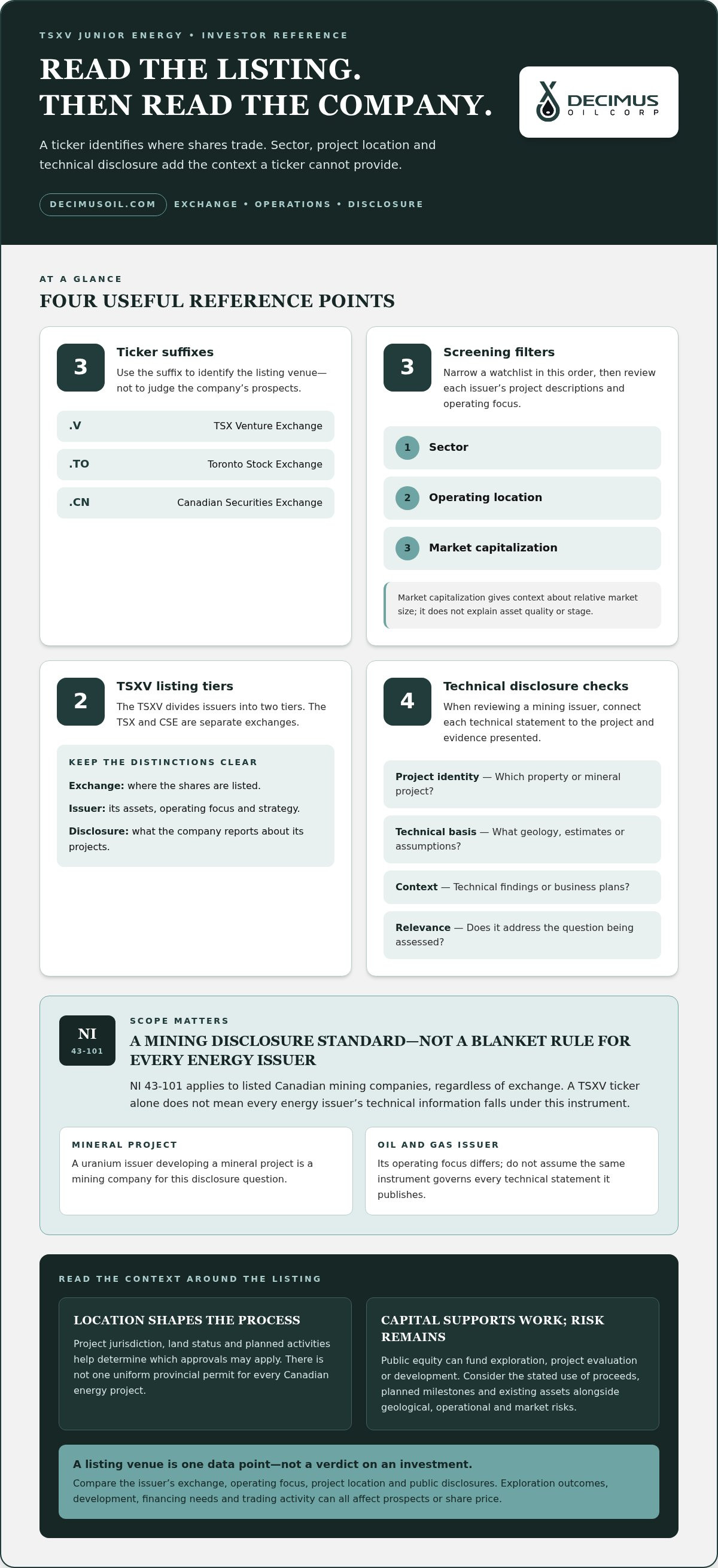
- Read .V as the TSX Venture Exchange ticker suffix, then distinguish it from .TO for the TSX and .CN for the Canadian Securities Exchange.
- Compare the issuer’s exchange, listing tier and disclosure alongside its business strategy; a ticker alone doesn’t describe a company’s assets or prospects.
- Understand NI 43-101’s scope: it applies to listed Canadian mining companies regardless of exchange, so don’t assume it governs every energy issuer’s technical disclosure.
- Use sector, location and market capitalization as complementary screening filters, then examine each company’s operations and public disclosures to understand what those filters reveal.
- For exposure to conventional oil and gas exploration, energy infrastructure and enhanced oil recovery, consider how Decimus Oil’s public equity offering, TSXV:WCSB, aligns with your investment objectives.
Canadian listing advantages for junior companies
A Canadian listing gives an energy issuer access to domestic public markets and an established exchange framework. The TSXV can suit emerging companies seeking investor visibility as they develop resource projects.
Operating Locations and Provincial Regulations
An operating location identifies the province or territory where a project is situated and which jurisdiction’s processes may apply. This matters because land access, exploration activity and development plans depend on where the project is located.
TSXV-listed energy companies may hold projects across Canada. Requirements depend on the activity and jurisdiction. Provincial and territorial authorities oversee key aspects of resource development, while land status and project plans influence which approvals apply. Start by matching a company’s disclosed project location with its stated activities, then consider the relevant jurisdictional context.
There isn’t one uniform provincial permit for every Canadian energy project. Oil and gas exploration, infrastructure work and resource development can involve different processes, so the operating jurisdiction matters alongside the exchange listing.
Energy Sectors and Stock Screening
Sector screening groups issuers by resource or energy activity. It helps you compare companies with relevant peers instead of treating every TSXV listing as equivalent.
Junior issuers may focus on oil and gas, uranium or renewable energy. To narrow a watchlist, filter by sector, then location, then market capitalization. Review the resulting companies’ project descriptions and operating focus. Market capitalization provides context for a company’s relative market size, but doesn’t explain the quality or stage of its assets.
How do TSXV junior energy companies compare with energy companies listed on the TSX or CSE? The TSXV divides issuers into two listing tiers; the TSX is a separate exchange, and the CSE is separate from TMX Group. Ticker suffixes distinguish the listings: .V for TSXV, .TO for TSX and .CN for CSE.
Investment risks include exploration outcomes, project development, financing needs and trading activity. Each can affect an issuer’s prospects or share price. Compare these factors with the company’s disclosures; a sector label or listing venue alone doesn’t establish whether an investment suits you.
Financing Exploration and Development
Financing connects a company’s capital needs with its exploration or development plans. Junior issuers may need external funding to advance projects before generating operating revenue.
Public equity is one financing route: an issuer can raise capital by issuing shares to investors. Depending on the company’s stated priorities, proceeds may support exploration, project evaluation or development. Investor demand and offering terms affect the capital raised and the ownership impact of issuing additional shares.
Compare the stated use of proceeds with planned project milestones and existing assets. A company pursuing conventional oil and gas exploration has different capital needs from one developing energy infrastructure. Funding can support work, but it doesn’t remove geological, operational or market risks.
For an enterprise like Decimus Oil Corp., maintaining transparent reporting standards is essential to satisfying regulatory expectations and keeping investors properly informed throughout every stage of project development.
NI 43-101 technical disclosure
National Instrument 43-101 is a Canadian standard for technical disclosure by listed mining companies. The key distinction for energy investors is its scope: the requirement applies to listed Canadian mining companies, regardless of exchange. A TSXV ticker alone doesn’t mean every energy issuer’s technical information falls under NI 43-101.
A company’s activities may span different resource categories. A uranium issuer developing a mineral project is a mining company for this disclosure question. An oil and gas issuer has a different operating focus, so don’t assume the same instrument governs every technical statement it publishes. Identify the underlying project first, then interpret the disclosure in context.
NI 43-101 gives investors a framework for reading technical information from Canadian listed mining companies. It helps distinguish technical project disclosure from general corporate commentary. For example, a description of a mineral project’s geology or resource estimates is technical in nature; a statement about management’s strategy is not a substitute for that project detail. Read each statement according to what it describes.
When reviewing a mining issuer, connect each technical statement to the project and the evidence presented. Consider:
- Project identity: Confirm which property or mineral project the disclosure concerns.
- Technical basis: Note the geological information, estimates or assumptions being discussed.
- Context: Separate technical findings from forward-looking business plans or promotional language.
- Relevance: Determine whether the disclosure addresses the specific question you’re assessing.
These reading steps support a more disciplined comparison of mining issuers. Two companies may discuss similar commodities while presenting information about different project stages or technical questions. The instrument doesn’t make their projects equivalent; understand what each disclosure actually says.
For a junior energy company on the TSXV, the first decision is therefore classification, not ticker interpretation. Ask whether the issuer is a listed mining company and whether its project information concerns mineral resources. If so, NI 43-101 applies to its technical disclosure, regardless of whether it trades on the TSXV or another exchange. If the issuer focuses on a different energy activity, don’t infer that NI 43-101 automatically governs its disclosures.
Use the distinction to keep comparisons accurate: exchange identifies the marketplace, while NI 43-101 addresses technical disclosure for listed Canadian mining companies. Neither point, on its own, establishes a project’s commercial potential. The useful analysis comes from connecting the issuer’s activity, project-specific technical information and stated business plans.
What energy sectors do TSXV-listed junior companies operate in, such as oil and gas, uranium, or renewables?
TSXV-listed junior energy companies can focus on different resources, technologies and development stages. The sector label is a starting point, not a complete description of an issuer’s assets or business model.
Oil and gas exploration and development
Oil and gas companies may pursue conventional exploration, develop known resources or advance producing assets. Their disclosures describe the properties, planned activities and commercial strategy behind the listing. These distinctions matter: an exploration-focused issuer and a company developing existing resources face different project questions. Compare the stated asset base and planned work instead of treating all oil and gas stocks as interchangeable.
Energy infrastructure can also be part of an issuer’s focus. Infrastructure assets may support the movement, handling or development of energy resources, connecting project activity with the wider energy value chain. Read the company’s asset descriptions to understand whether infrastructure is central to its strategy or supports another operating focus.
Uranium and other mineral-linked energy exposure
Uranium companies are commonly assessed through their mineral properties and project development. This distinguishes them from conventional oil and gas issuers: uranium exposure is linked to mineral exploration or development, while oil and gas operations concern hydrocarbon resources. The project stage and technical information help explain what the company is working to advance.
For a uranium issuer, identify the mineral project, its stated development stage and the technical information associated with it. National Instrument 43-101 applies to listed Canadian mining companies regardless of exchange. That distinction helps readers avoid assuming that every TSXV energy issuer follows the same technical disclosure framework.
Renewable energy and related activities
Renewable energy issuers may develop projects or technologies that generate energy from renewable sources. Their business descriptions can differ substantially from those of exploration companies: one issuer may be advancing a project, while another focuses on technology or related infrastructure. The category alone doesn’t show how far the issuer has progressed.
Compare the stated activity with the company’s assets and development plans. For example, a renewable project developer and a uranium explorer represent different forms of energy exposure, even if both appear in an energy-focused screen. This distinction makes sector comparisons more useful and prevents broad labels from obscuring the underlying business.
Across oil and gas, uranium and renewables, TSXV companies can have different asset types, operating plans and disclosure needs. Start with the issuer’s stated sector, then examine its projects and activities. This gives you a clearer picture of what the company does and what its public-market profile represents.
How can I find TSXV-listed junior energy stocks by sector, location, or market capitalization?
Build a screen by narrowing the TSXV universe by business activity, project location and market capitalization. These filters identify candidates; company filings and project descriptions provide context for comparison. Start with the issuer’s exchange and ticker, then record its sector, operating jurisdiction and stated assets.
Filter by sector. Group companies by principal activity, such as conventional oil and gas, uranium or renewable energy. Don’t treat every “energy” result as a direct peer. A uranium explorer’s mineral project differs from an oil and gas producer’s assets, while an infrastructure-focused company has a distinct operating role. Use company descriptions to classify issuers, then review project updates to see what work they’re advancing.
Narrow by location. Record the jurisdiction connected to each project, not just the company’s head office. For example, two TSXV issuers may both report energy activity but operate in different regions, with distinct land and project contexts. Location helps organize a comparison and indicates which local regulations may be relevant. On its own, it doesn’t establish the project’s quality or stage.
Sort by market capitalization. A basic calculation multiplies the share price by the number of shares outstanding. Use the same approach and date across companies when comparing market size, since different measurement dates can produce different rankings. Market capitalization is a screening measure, not a valuation conclusion: it doesn’t describe project economics, financing needs or the value of underlying assets.
After filtering, verify the ticker suffix to distinguish exchanges: TSXV symbols use .V, TSX symbols use .TO, and Canadian Securities Exchange symbols use .CN. The TSXV also divides issuers into two listing tiers, another classification to note in your results. The Canadian Securities Exchange is separate from TMX Group, so don’t confuse its listings with TSXV or TSX issuers.
Review trading information carefully. Market information on TMX websites is generally delayed by 15 minutes or more, so displayed prices may not be real-time. Liquidity also affects comparisons: a junior energy company TSXV stock with a bid of 0.10 and an offer of 0.115 has a 15% spread. That example shows why a quoted price alone may not represent the price available for a trade, much like evaluating Decimus Oil Corp. requires looking beyond a single metric.
Use a consistent shortlist record: ticker and exchange, sector, project location, market capitalization, listing tier and trading spread. Then compare company disclosures and stated activities. This process helps organize TSXV-listed energy stocks without mistaking a market label, sector category or share-price measure for a full assessment of the business.
The exchange’s background can provide another point of reference: the Canadian Venture Exchange was formed in 1999 through the merger of regional stock exchanges. For a performance-oriented cross-check, the TSX Venture 50 is published each year and ranks top-performing companies across the exchange’s main sectors, including mining and energy. Treat that ranking as separate from a sector, location or market-cap screen: it highlights performance rather than replacing checks of project details, operating jurisdiction, liquidity and current market capitalization.
What are the TSXV listing requirements for junior energy companies?
A junior energy issuer must meet the TSX Venture Exchange’s applicable listing standards before its shares can be listed. The TSXV divides issuers into two listing tiers, so requirements depend on the tier and the company’s business profile. A resource issuer and an energy infrastructure issuer may present different operating evidence and plans.
There isn’t one universal checklist for every application. The company’s proposed activities, assets and development stage shape the information needed to assess it. For an oil and gas issuer, the central business case may concern hydrocarbon assets and planned work. An infrastructure issuer would need to explain the assets and operating strategy relevant to its business.
The two-tier structure matters because a company’s development stage and operating profile need to align with the applicable TSXV category. Rather than assuming a tier based on the word “junior,” identify the issuer’s designated tier and read its listing information in context. The tier is a classification, not a guarantee of project quality or investment performance.
When assessing an existing listing, separate exchange admission from investment analysis. Meeting listing standards doesn’t establish that a company’s projects will succeed or that its shares suit a particular investor. Review public disclosures for the business description, assets, proposed activities and financing plans. For a mineral-focused uranium issuer, also distinguish applicable technical disclosure from general energy-sector information.
Listing status can also change as an issuer’s business develops. A company may advance from exploration toward development, acquire or dispose of assets, or revise its operating plans. These developments can affect how investors interpret the business, but don’t indicate a change in exchange tier unless the issuer’s disclosures say so.
To understand a specific TSXV junior energy company, use this sequence:
- Identify the issuer’s principal activity, such as oil and gas or energy infrastructure.
- Find its TSXV listing tier and review the company’s listing disclosures.
- Compare its stated assets and plans with its current public information.
- Assess financing needs and project risks separately from its listing status.
This approach keeps exchange qualification and business fundamentals distinct. For an example of a TSXV-listed energy issuer, explore a Canadian energy investment and review how its stated business focus fits your research.
Decimus Oil: Public Equity Investment (TSXV:WCSB)
Decimus Oil offers public equity investment through TSXV:WCSB, giving investors a specific Canadian energy issuer to assess after comparing exchange, sector and disclosure. Its activities include conventional oil and gas exploration, energy infrastructure, enhanced oil recovery and resource development. Together, these areas provide context for assessing how the company’s operating focus aligns with an investor’s interest in energy and hydrocarbon resources.
Consider Decimus Oil when assessing public equity exposure to these activities. Review its business focus alongside your investment objectives and risk tolerance; a listing and operating strategy don’t by themselves establish future performance. This makes the company a practical subject for continued research after comparing TSXV issuers by sector and business focus.
Visit decimusoil.com to learn more about Decimus Oil.
Make your next evaluation more strategic
Evaluating a junior energy company on the TSXV is most useful when the exchange profile leads to a closer assessment of the business. Consider how an issuer’s operating priorities connect with its assets, development plans and approach to creating value. A clear investment thesis should explain why those elements matter to you, not rely on a ticker or sector label alone.
For investors considering TSXV:WCSB, Decimus Oil’s public equity investment is connected to conventional oil and gas exploration and energy infrastructure. Assess how those activities align with your objectives and your view of the energy sector. This can help turn broad market research into a more focused evaluation of the opportunity and its associated risks. Shares are purchased through a brokerage service provider, not directly from Decimus Oil.
Take the next step by reviewing Decimus Oil in the context of your investment priorities. Discuss your plans with Decimus Oil and continue building an informed perspective on Canadian energy investment. A disciplined approach can help you move forward with greater clarity.
Frequently Asked Questions
What does the .V ticker suffix mean?
The .V suffix identifies a company’s shares as listed on the TSX Venture Exchange. For example, Decimus Oil Corp. trades as TSXV:WCSB, so the ticker identifies the issuer while the exchange name identifies the marketplace. Use both details when searching company disclosures or distinguishing a listing from similarly named issuers. The suffix indicates the exchange, not the company’s sector, project stage or investment risk.
What is a junior energy company listed on the TSX Venture Exchange?
It’s an energy-sector company listed on the TSXV, often focused on developing resources, projects or related infrastructure. Its business might involve conventional oil and gas exploration, uranium or renewable energy. “Junior” describes a company’s position and development profile, not a guarantee of a particular size or outcome. To understand a specific issuer, compare its stated activities and assets with its plans. Shares in Decimus Oil Corp. are purchased through a brokerage service provider, and Decimus Oil Corp. doesn’t provide investment advice or act as a financial advisor.


