
The biggest oil opportunity isn’t always the one with the largest resource base. A conventional oil play investment may suit a beginner who understands that value depends on oil prices, recoverable resources, technology and the investment cycle, and that oil-related investments can be volatile. In Canada, conventional oil and gas resource investment is generally more than double non-conventional resource investment, but that scale alone doesn’t make any particular investment a good fit.
A careful approach is sensible: oil prices move with market conditions and geopolitics, while a company’s production, operating methods and asset quality also shape its prospects. For new investors, the challenge is weighing these factors without treating a promising resource or rising oil price as a guarantee of returns.
This article explains how conventional and unconventional resources differ, how technology can affect an asset’s value, and how Canadian investment cycles have shifted over time. It also looks at why oil prices and production matter, and what beginners should consider when assessing exposure to conventional oil plays.
Key Takeaways
- Assess oil-price exposure alongside a company’s production, assets and ability to respond to changing market conditions.
- Compare conventional and unconventional resources by considering how they are developed and what that means for investment exposure.
- Evaluate how exploration and recovery technology can affect the amount of a resource that is economically recoverable.
- Use Canada’s past investment cycles to understand how oil and gas spending can expand and contract with market conditions.
- Look beyond the region: weigh reserve quality, management and production trends when assessing Canadian oil companies.
Factors affecting oil-related investment prices
Oil shares respond to more than the daily price of a barrel. Investors also assess production, operating costs, reserves, debt and the wider commodity outlook. These factors can move in different directions: rising production may partly offset falling oil prices, while higher costs can erode that benefit.
Geopolitics can shift expectations quickly. Oil prices spiked in March 2026 following the conflict in Iran, showing how events can affect supply concerns and market sentiment. For a conventional oil play investment, the practical question is how a company’s assets and finances would perform if prices changed, not simply whether prices are rising today.
Event-study analysis looks at share-price returns around a defined event, such as an acquisition or asset sale announcement. One study analysed 1,282 oil and gas resource acquisition announcements and 1,503 divestiture announcements from 1989 to 2011. Those sample counts describe the study’s scope; they don’t, on their own, establish how a particular company’s shares will react.
Oil’s relationship with other assets can change, too. Correlation describes how two investments have moved in relation to each other over a period; it doesn’t show that one caused the other. Compare an energy holding with the rest of your portfolio, and consider whether it adds diversification or concentrates risk during a market shock.
Oil and natural gas share some influences, including energy demand and production decisions, but their prices don’t move in lockstep. Regional supply, transportation limits, storage and seasonal demand can affect gas differently. Assess each commodity separately rather than assuming an oil-price rise will lift every energy producer’s earnings.
Global commodity prices add another layer. Economic activity can affect demand, while geopolitical policy and efforts to reduce reliance on oil shape longer-term expectations. Oil and the broader Resources sector are volatile, and future oil prices cannot be predicted accurately. A sound assessment considers how a company could fare under different market conditions.
What are the latest Canadian conventional oil production costs and breakeven prices? There is no single cost or breakeven price for Canadian conventional producers. Results depend on the field, production profile, operating requirements and access to markets. Compare a producer’s realized revenue with its costs and required investment to assess its sensitivity to price changes.
What are current oil price forecasts and their impact on conventional producers? A forecast matters because it influences expected revenue relative to a producer’s costs, production and spending plans. Higher expected prices can support cash flow, while weaker expectations can constrain investment and pressure valuations.
What dividends and returns have Canadian conventional oil producers delivered? Dividends and investment returns vary by company and over time. Assess cash generation, debt, capital spending and dividend policy rather than treating past distributions as a reliable guide to future returns.
What are the main financial and operational risks? Key risks include volatile oil prices, cost overruns, production interruptions, reserve uncertainty and difficulty accessing markets. Debt and high spending needs can magnify the financial impact when prices fall or operations underperform.
Conventional versus unconventional resource investments
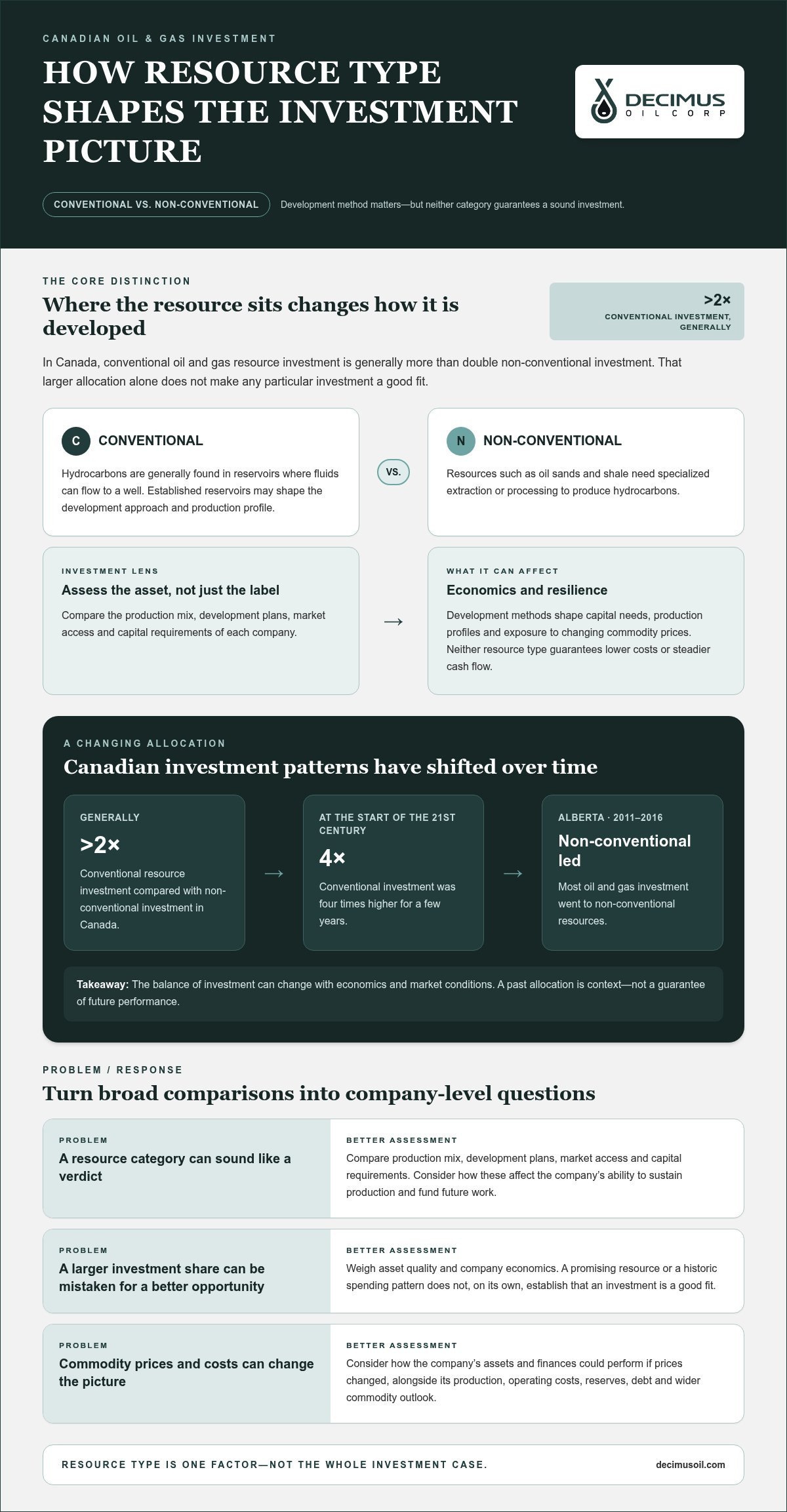
Conventional and unconventional describe how hydrocarbons are held and produced, not whether an investment is automatically sound. Conventional oil and gas are generally found in reservoirs where fluids can flow to a well; unconventional resources, such as oil sands and shale, need specialized extraction or processing. That difference shapes development methods, capital needs, production profiles and exposure to changing commodity prices.
Canadian investment patterns show why the distinction matters. Conventional oil and gas resource investment is generally more than double non-conventional investment. At the beginning of the twenty-first century, it was four times higher for a few years. The balance shifted in Alberta from 2011 to 2016, when most oil and gas investment went to non-conventional resources. The sector’s allocation can change with economics and market conditions.
For investors, the key comparison is economic resilience. Conventional assets may produce from established reservoirs, while unconventional projects can require extensive infrastructure and processing. Neither category guarantees lower costs or steadier cash flow. Compare each company’s production mix, development plans, market access and capital requirements. Then consider how these factors affect its ability to sustain production and fund future work.
What Canadian taxes, royalties, and regulations apply to conventional oil investments? Companies may face corporate income taxes, while oil and gas production is subject to royalties and operating rules. Applicable amounts and requirements depend on the jurisdiction, resource and investment structure, so review company disclosures to understand how these obligations are handled.
How do investors assess reserves, decline rates, and production growth? Compare reported reserves with current production, then examine how quickly existing wells decline and what investment is planned to replace or grow output. Reserve quality, development economics and production trends together indicate whether a company can sustain its resource base.
How can investors evaluate conventional oil stocks, funds, and private partnerships? For stocks, review reserves, production, debt and management; for funds, examine holdings, concentration and fees. For private partnerships, focus on asset exposure, governance, liquidity and how returns and expenses are allocated. Each structure offers different access to the resource sector and different exposure to losses.
A practical comparison starts with the asset, then considers the investment vehicle. Ask whether the resource is producing or still being developed, how operating requirements affect its economic value, and whether the company can finance its plans. Compare these factors across conventional and unconventional holdings before deciding how either fits within a diversified portfolio.
For an example of how Canadian conventional resources connect with development activity, explore conventional oil and gas exploration.
Technological complexity and investment value
Technology affects how much oil a conventional reservoir can produce and what it takes to maintain output. A well may flow naturally at first, then require artificial lift as reservoir pressure falls. Investors should distinguish initial production from the longer-term production profile. Equipment, maintenance and power needs influence operating performance, while interruptions can reduce saleable volumes and cash flow.
Exploration technology also shapes the uncertainty around an asset. Geological interpretation and drilling help identify and test potential reservoirs, but a prospect still needs successful wells and an economic development plan. Exploration can take time: drilling an exploration well usually takes longer than 5 years. For investors, that timeline means potential resources should not be treated as current production or near-term revenue.
Recovery methods can change the value of producing fields. Water injection, for example, can help maintain reservoir pressure, while enhanced oil recovery techniques may target oil left behind by conventional production. These approaches require technical planning and investment. Consider whether the expected increase in recoverable oil justifies the added work, and whether the project suits the asset’s geology and production history.
Technology matters beyond the wellhead. Gathering systems, processing facilities and pipelines connect production with buyers, and transportation constraints can affect the ability to sell output. A field’s value therefore depends partly on the infrastructure available to move its product. Before treating production forecasts as likely cash generation, assess how operational plans account for access, reliability and maintenance.
Innovation can improve drilling and exploration outcomes, but a technology label alone says little about investment quality. Compare the method with the company’s actual results: production trends, well performance, recovery rates and required capital spending. The key question is whether the approach improves the asset’s economics, not whether it sounds advanced. Technology can support profitability, but it cannot remove commodity volatility.
Use a consistent review process when comparing oil stocks:
- Separate producing assets from undeveloped prospects in reported resource information.
- Compare production trends with the spending needed to sustain or increase output.
- Review infrastructure access and the operational steps required to bring oil to market.
- Consider how recovery methods affect expected production, project complexity and capital needs.
These checks help investors connect technical choices to financial outcomes. A conventional oil play investment may look attractive because of its resource base, yet development timing, recovery methods and transportation access determine how that resource can become sales. Compare these factors with management’s plans and the company’s ability to fund execution. This gives a clearer view of how technology may affect asset value, production and exposure to volatility.
Canadian oil and gas investment cycles
Canadian oil and gas investment has moved through pronounced expansion and contraction. It reached C$50 billion in 2008, when the industry represented 18% of total industrial investment in Canada. By mid-2014, investment had climbed above C$80 billion, and oil and gas accounted for 24% of industrial investment. These peaks show how strongly the sector can influence national capital spending during an expansion.
The following downturn changed that picture. In 2020, Canadian oil and gas investment fell to C$24 billion, more than two-thirds below its 2014 peak. Oil and gas represented 7% of total industrial investment that year, its lowest share in close to three decades. For investors, this contraction illustrates how quickly project spending and activity can recede when market conditions weaken.
The recovery outlook also moved in stages. Canadian oil and gas investment in 2022 was likely to be one-third higher than the 2020 low. That projected increase indicates a rebound from a depressed base, not a return to the mid-2014 peak. Investment cycles matter because capital budgets influence drilling, development, infrastructure use and the future supply available from Canadian fields.
Investment cycles affect companies differently. During expansion, stronger spending can support new projects and production growth, but it can also increase competition for capital and services. During a contraction, companies may defer development, focus on existing assets or reduce spending. When comparing returns across a cycle, distinguish operating performance from the broader rise or fall in industry investment.
Use historical periods as context, not as a timetable for the next cycle. Rising investment doesn’t mean every producer will benefit equally, and a sector-wide decline doesn’t describe each company’s financial position. Compare a company’s production plans, capital discipline, debt and asset mix with the conditions behind each period. This helps show whether its strategy depends on continued expansion or can adapt during a contraction.
For a portfolio, the central lesson is exposure to cyclical risk. Canadian oil and gas investment reached sharply different levels in 2008, 2014 and 2020, so investors should consider how much sector concentration they can tolerate. Review the company’s operating results alongside national spending trends, and separate long-term asset potential from short-term changes in investment activity.
A practical cycle review can focus on three comparisons:
- Compare current company spending plans with its production and development priorities.
- Set the 2020 contraction against the 2014 investment peak to understand historical sensitivity.
- Assess whether a portfolio’s energy exposure remains aligned with its overall investment objectives.
Canadian investment cycles don’t move in a straight line. The contrast between C$80 billion-plus in mid-2014 and C$24 billion in 2020 shows why supply, capital allocation and expected returns should be considered together. Investors can use those historical turning points to frame risk, then evaluate each company on its own operating and financial performance.
Which Canadian conventional oil companies and regions offer investment opportunities?
Assess company fundamentals before choosing a province or basin. Well-established, well-managed oil companies with high-quality reserves and rising production can be candidates for further analysis. Those qualities don’t eliminate commodity exposure, but they help investors assess whether a business has producing assets and a plan to sustain or grow output.
Compare a company’s market capitalization with the estimated value of its reserves. This can help indicate whether the market appears to value the business above or below its resource base. It isn’t a standalone valuation: reserve quality, production costs, debt, development plans and infrastructure access all affect the value that can ultimately be realized.
Production trends offer another practical screen. Check whether output is rising, stable or declining, then compare that trend with the company’s development activity and spending priorities. A producer with rising production may be better positioned to offset weaker oil prices, but assess how growth is achieved and whether existing assets can support it over time.
Geographic diversification matters, too. Consider oil companies with drilling sites in multiple locations where exploration has succeeded in the past. A spread of assets can reduce reliance on one area’s geology or operating conditions. It doesn’t remove sector-wide risks, so examine whether each location contributes meaningful production and fits the company’s development strategy.
Alberta warrants a distinct look in any Canadian review. Most Alberta oil and gas investment went to non-conventional resources from 2011 to 2016, illustrating why provincial investment totals don’t automatically indicate conventional activity. Assess the specific company’s asset mix and producing properties rather than assuming that a region’s overall energy profile represents every operator.
Technology can distinguish one company from another. Consider oil stocks using innovative drilling and exploration techniques, and look for evidence that these methods support production or improve resource development. Connect the stated approach to operating results, reserve quality and capital requirements. A technology claim alone does not demonstrate stronger investment value.
For a structured comparison, review these factors together:
- Reserve quality and estimated reserve value relative to market capitalization.
- Production direction and the company’s plans for sustaining or growing output.
- Asset locations, exploration history and exposure across operating areas.
- Drilling and exploration methods, considered alongside results and spending needs.
- Management quality and the company’s ability to develop its resources.
Investors seeking exposure through funds can assess whether an ETF holds established oil companies with these characteristics, then review its holdings and concentration. The choice between individual stocks and a fund depends on the desired exposure and the investor’s ability to assess company-specific risks. Explore Canadian conventional oil investment opportunities as you compare resource development approaches.
Decimus Oil: Public Equity Investment (TSXV:WCSB)
Decimus Oil Corp. offers public equity investment through TSXV:WCSB for readers assessing exposure to Canadian conventional oil and gas. Its activities include conventional oil and gas exploration, energy infrastructure, resource development and enhanced oil recovery. These offerings connect investment exposure with hydrocarbon exploration and development, while public equity remains subject to market and company-specific risks.
Consider Decimus Oil Corp. if you’re evaluating a publicly traded energy company alongside the factors discussed above, including resource quality, production potential and investment cycles. Reviewing the company’s public information can help you understand its approach before making an investment decision.
For more information, visit decimusoil.com.
Make your next investment decision with purpose
Treat a conventional oil play investment as a thesis to keep testing, not a fixed prediction. Define what evidence would strengthen your view, what could change it, and how much sector exposure fits your broader portfolio. This keeps decisions tied to asset execution and market developments rather than short-term sentiment. Revisit your criteria as company performance and market conditions evolve.
For investors considering Canadian energy exposure, Decimus Oil offers public equity investment through TSXV:WCSB, alongside conventional oil and gas exploration and energy infrastructure. These offerings connect public-market participation with resource activity. Reviewing the company’s public information can help you assess its approach and decide whether it aligns with your investment objectives and risk tolerance.
For a next step, discuss oil investment with Decimus Oil. A considered, informed approach can help you move forward with greater clarity.
Frequently Asked Questions
Is investing in oil suitable for beginners?
Conventional oil exposure may suit beginners who understand the risks and choose an investment that fits their portfolio and financial goals. Start by learning how company earnings respond to oil prices, production changes and operating decisions. Compare a single producer’s shares with a fund holding several energy companies, and consider whether you can tolerate price declines without making rushed decisions. Oil exposure isn’t a substitute for a diversified investment plan.
Is there a connection between crude oil prices, other commodity prices, or other financial assets?
Yes, but these relationships can change over time and aren’t reliable predictors. Oil demand may move with global economic activity, while supply disruptions can affect crude independently of other commodities. Canadian investors should also consider currency movements: a US-dollar oil benchmark can affect how energy-market changes translate into Canadian-dollar returns. Compare assets over the same period, and remember that historical co-movement doesn’t establish what happens next.
What is a conventional oil play investment?
A conventional oil play investment means exposure to a company or financial vehicle connected to oil produced from conventional reservoirs. That exposure may come through shares in an exploration and production company or a fund holding energy stocks; it doesn’t mean owning or taking delivery of crude oil. Before investing, identify whether the underlying business has producing assets, exploration prospects or a mix, since these profiles involve different development and operating considerations.
How can investors invest in conventional oil plays in Canada?
Canadian investors can consider publicly traded oil-company shares, energy-focused exchange-traded funds or private partnerships. Compare the investment structure, holdings, liquidity and company disclosures before deciding. Decimus Oil shares trade on the TSX Venture Exchange as WCSB and must be purchased through a brokerage service provider, not directly from the company. Decimus Oil doesn’t provide investment advice or act as a financial adviser.
How do conventional oil investments compare with oil sands and shale investments?
They differ in how resources are developed, produced and connected to infrastructure. Conventional projects target oil in reservoir formations; oil sands projects involve extracting bitumen, while shale development relies on specialized well techniques. These differences can affect capital needs, operating plans and production profiles, but they don’t mean one category is always cheaper or more profitable. Compare individual companies’ assets, project plans and financial capacity rather than relying on resource labels alone.
What dividends and returns have Canadian conventional oil producers delivered?
Dividends and returns vary by company and over time. Assess cash generation, debt, capital spending and dividend policy rather than treating past distributions as a reliable guide to future returns.


