
While broader markets often focus on blue-chip stability, the 2026 TSX Venture 50 companies delivered a staggering average share price appreciation of 431%. This explosive growth potential draws many investors toward TSX Venture energy stocks, yet the path to consistent returns is often obscured by technical jargon and market noise. It's understandable if the inherent volatility of small-cap energy makes you hesitate. Many investors find it difficult to distinguish between high-quality junior producers and promotional entities that lack the technical depth to realize long-term value.
This strategic guide provides a clear framework to help you evaluate junior producers and identify high-potential assets within the Canadian energy sector. You'll discover how to assess the fundamental value of conventional versus unconventional assets and learn why strong insider alignment is a critical indicator of corporate integrity. We'll strip away the complexity of regulatory filings to reveal the operational metrics that truly matter. By the end of this article, you'll have the tools to identify sophisticated operators that combine decades of geological expertise with modern, high-intensity methodologies to drive shareholder value.
Key Takeaways
- Understand the strategic role of the TSX Venture Exchange as a premier incubator for junior producers within the robust Canadian energy landscape.
- Identify high-potential TSX Venture energy stocks by prioritizing companies with significant insider alignment and management teams possessing decades of technical expertise.
- Distinguish between the capital intensity of unconventional shale plays and the reliable value discovery found in conventional oil and gas exploration.
- Master a framework for portfolio diversification that balances the high-growth potential of junior energy issuers with the stability of senior producers.
- Evaluate how strategic infrastructure management and enhanced oil recovery techniques can maximize the lifecycle value of Western Canadian energy assets.
The Role of the TSX Venture Exchange in the Canadian Energy Sector
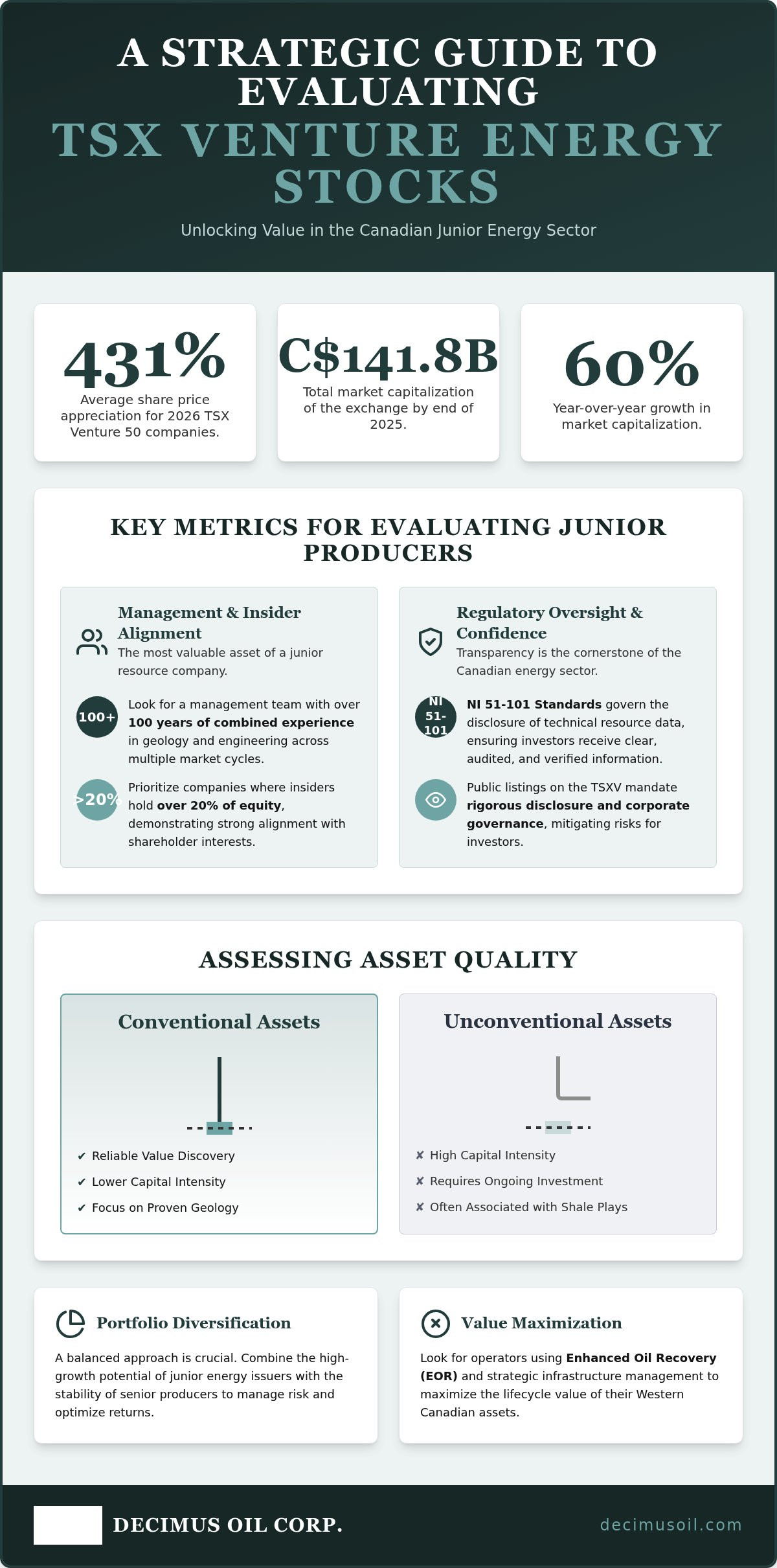
The TSX Venture Exchange serves as a critical engine for the global energy sector, acting as a premier incubator for junior producers. Canada has long maintained its position as a dominant hub for public equity investment in hydrocarbons, providing a sophisticated ecosystem where technical expertise meets disciplined capital. For investors, this concentration creates a unique environment where TSX Venture energy stocks benefit from a deep pool of specialized knowledge and high-tier infrastructure. The total market capitalization of the exchange reached approximately C$141.8 billion by the end of 2025, reflecting a significant 60% increase from the previous year. This growth underscores the exchange's role in supporting the transition from early-stage exploration to mid-tier production.
The liquidity advantages of trading on a regulated Canadian exchange cannot be overstated. Unlike private equity investments that may lock up capital for years, the TSXV provides a transparent marketplace for price discovery and exit strategies. This accessibility allows individual and institutional investors to participate in the growth of the Western Canadian Sedimentary Basin with the confidence that their positions can be managed in real time. It's a structure that rewards operational efficiency and technical success, providing a clear pathway for junior firms to graduate to the senior TSX board as they realize their production targets.
Access to Growth Capital and Institutional Interest
Junior producers require significant capital to realize large-scale projects, and the TSXV provides the necessary conduit to reach a diverse range of investors. Canadian institutional funds play a vital role here, often supporting the energy ecosystem by providing the strategic capital required for resource development and infrastructure expansion. The TSX Venture Exchange functions as a strategic platform that bridges the gap between private exploration and a senior exchange listing. This progression allows companies to scale their operations while maintaining the liquidity advantages of a regulated public marketplace. The 2026 TSX Venture 50 companies demonstrated this potential clearly, showing that disciplined junior firms can achieve substantial market cap increases through successful execution.
Regulatory Oversight and Investor Confidence
Transparency is the cornerstone of the Canadian energy sector. Strict reporting standards for oil and gas issuers ensure that investors have access to clear, audited data regarding reserves and production capabilities. Public listings help mitigate the risks associated with junior exploration by mandating rigorous disclosure and corporate governance. A key component of this framework is the NI 51-101 standards, which govern how TSX Venture energy stocks disclose technical resource data. These regulations provide a level of confidence that is often missing in less regulated jurisdictions, allowing stakeholders to make informed decisions based on verified geological and financial performance. By adhering to these high standards, junior producers signal their commitment to professional integrity and long-term value creation.
Key Metrics for Evaluating Junior Energy Stocks
Identifying high-potential TSX Venture energy stocks requires moving beyond simple price charts. Successful investors look at the qualitative and quantitative markers that signal long-term viability in a capital-intensive industry. Technical proficiency and capital discipline are the primary drivers of success in the Western Canadian Sedimentary Basin. Success requires discipline. By focusing on fundamental strengths, you can filter out promotional companies and focus on those with the capacity to scale.
Assessing Management and Insider Alignment
A company's leadership team is its most valuable asset. When evaluating junior resource companies, look for a management track record that spans several market cycles. A team with over 100 years of combined experience in geology and engineering understands how to navigate the technical complexities of oil and gas extraction. High insider ownership is another vital metric. Companies where the board and executives hold over 20% of the equity demonstrate a clear "skin in the game" culture. This alignment ensures that management's interests are directly tied to shareholder value. For instance, Decimus Oil Corp. maintains over 27% insider ownership, which reflects a high degree of confidence in their strategic direction.
Infrastructure and Resource Development Strategies
Asset quality is defined by more than just what's in the ground. It's about the ability to bring those resources to market efficiently. Owning energy infrastructure is a significant strategic advantage for junior producers. It reduces reliance on third-party processing and lowers operational costs. This protects margins during periods of price volatility. Enhanced oil recovery (EOR) techniques also play a crucial role in extending the life of mature assets. By optimizing existing wells, companies can realize value from proven reserves without the high risk of frontier exploration.
Stability can be measured through production growth trends. Analyzing a firm's performance since 2021 provides a clear picture of its operational consistency. A steady upward trajectory in production, combined with disciplined resource development, indicates a sophisticated operator. Investors who prioritize these metrics are better positioned to identify resilient TSX Venture energy stocks. If you're looking for an example of this disciplined approach, you can review conventional exploration strategies that prioritize long-term asset value.
Conventional vs. Unconventional Assets: Assessing Long-Term Value
Distinguishing between asset types is vital when analyzing TSX Venture energy stocks. While unconventional shale plays often dominate headlines, the stability of conventional oil and gas exploration in Western Canada remains a cornerstone of strategic investment. Conventional reservoirs typically offer lower decline rates and more predictable production profiles compared to the rapid depletion seen in many shale basins. This characteristic allows junior producers to maintain steady cash flow without the constant, high-capital pressure of drilling new wells just to offset production drops. It's a model built on sustainability and disciplined growth rather than high-risk speculation.
Horizontal drilling has revitalized these traditional reserves. By applying modern drilling techniques to established conventional pools, operators can access previously bypassed hydrocarbons with significantly higher recovery factors. This methodology combines the lower risk of a proven geological setting with the enhanced productivity of modern engineering. It's a calculated approach that prioritizes long-term asset depth over short-term volume spikes. For investors, this means backing companies that understand how to extract maximum value from the Western Canadian Sedimentary Basin through technical precision.
The Economics of Conventional Resource Extraction
Conventional resource development significantly lowers the break-even point for junior producers. Because these projects don't require the massive hydraulic fracturing stages associated with unconventional plays, the initial capital outlay is much more manageable. Focusing on high-potential conventional plays allows companies to optimize their balance sheets and remain resilient during downturns. Conventional assets provide a buffer against commodity price volatility by maintaining profitable margins even when WCS or AECO prices fluctuate. This economic resilience is a key reason why sophisticated investors target these specific types of TSX Venture energy stocks as part of a balanced portfolio.
Enhanced Oil Recovery (EOR) as a Value Driver
Secondary recovery methods are essential for maximizing the lifecycle value of a reservoir. Implementing EOR techniques, such as waterflooding or gas injection, allows producers to maintain reservoir pressure and increase ultimate hydrocarbon output. This strategy reduces the need for high-risk "wildcat" exploration, as value is realized from existing, well-understood assets. There is a powerful synergy between owned infrastructure and EOR efficiency. When a company manages its own pipelines and processing facilities, the cost of implementing secondary recovery drops, further enhancing the net present value of the field. This focus on operational optimization ensures that every barrel produced contributes more effectively to the bottom line and shareholder equity.
Strategic Portfolio Diversification with Small-Cap Energy Stocks
Investors seeking to optimize their energy portfolios must balance the steady yields of senior producers with the aggressive capital appreciation potential of TSX Venture energy stocks. While large-cap majors focus on maintaining dividends through mature production, junior issuers are structured to realize value through rapid resource development and strategic asset acquisitions. This high-growth segment allows stakeholders to participate in the early stages of a discovery's lifecycle, where the potential for share price expansion is most significant. A balanced approach involves allocating capital to both established entities and sophisticated junior operators to capture the full spectrum of the energy value chain.
Realizing value often involves a methodical cycle of acquisitions and divestitures. Junior firms that can identify undervalued assets, optimize them through modern engineering, and later divest non-core properties are positioned to maximize shareholder returns. This strategy ensures that capital is consistently recycled into the highest-return projects, maintaining a lean and focused operational profile. By focusing on these value-creation events, investors can achieve growth that often outpaces the broader commodity markets.
Identifying Growth Catalysts in the Energy Sector
Asset valuation is frequently tied to regional infrastructure development. When a junior producer secures access to pipelines or processing plants, it immediately improves the netback of every barrel produced by reducing third-party costs. Public equity investment provides a direct conduit to this growth, offering a level of liquidity and transparency that private ventures cannot match. Timing an entry into these stocks requires a close analysis of operational milestones. Investors should look for companies approaching significant drilling programs or those nearing the completion of infrastructure projects that will unlock dormant production capacity. To see how these principles are applied in practice, you can explore investment opportunities in conventional energy.
Risk Mitigation and Strategic Alignment
Exposure to diversified resource development projects across different formations within the Western Canadian Sedimentary Basin (WCSB) is a proven method for mitigating geological risk. By targeting varied reservoirs, a company ensures that its success isn't dependent on the performance of a single play. Operational efficiency remains the primary defense against market volatility; a resilient balance sheet is maintained through disciplined cost management and a focus on high-margin conventional production. This reflects a state of strategic optimism, where a company's growth plan is grounded in technical proficiency and proven capability. Strategic alignment also involves evaluating the depth of a company's technical board. When directors possess a profound understanding of reservoir engineering and corporate finance, they can better navigate the complexities of resource development while maintaining professional integrity.
Decimus Oil Corp. (TSXV:WCSB): A Case Study in Operational Excellence
Decimus Oil Corp. exemplifies the strategic potential found in TSX Venture energy stocks. By focusing on conventional oil and gas exploration within the Western Canadian Sedimentary Basin, the company has established a disciplined operational footprint. This focus on proven basins reduces the inherent risks of greenfield exploration while providing a clear pathway for resource development. Decimus operates with a commitment to maximizing the value of every asset through technical precision and high-intensity methodologies. Their strategy is rooted in regional expertise. Decimus prioritizes results.
A core trust signal for any junior issuer is the level of insider alignment. Decimus maintains over 27% insider ownership, ensuring that the leadership team's interests remain perfectly synchronized with those of the shareholders. This high stake reflects a profound confidence in the company's asset base and its long-term growth trajectory. By managing their own energy infrastructure and utilizing enhanced oil recovery (EOR) techniques, Decimus optimizes operational margins and drives capital appreciation. These efficiencies allow the firm to realize value from existing production while maintaining a lean cost structure that is resilient to market shifts.
Proven Leadership and Regional Expertise
The company leverages over a century of combined experience in the Canadian energy sector to navigate complex geological and regulatory landscapes. This seasoned leadership team combines deep historical knowledge of the WCSB with modern engineering practices to optimize asset performance. Their commitment to operational integrity and professional execution is evident in their steady growth tracked since 2021. Decimus is not just a service provider; it's a sophisticated operator deeply integrated into the regional landscape. They focus on professional integrity. Every project is executed with high-level precision.
Pathways to Investment and Future Growth
For investors seeking direct exposure to the Canadian energy sector, Decimus offers a transparent pathway through its public listing. Trading under the ticker TSXV:WCSB, the company provides a liquid entry point into a growth-oriented producer. The outlook for the firm remains focused on optimizing resource development and expanding its conventional asset base through disciplined capital allocation. As the energy market continues to evolve, resilient TSX Venture energy stocks like Decimus stand as a prime example of how junior producers can thrive through technical proficiency and strategic alignment. You can learn more about Decimus Oil Corp. investment opportunities to understand how their conventional focus translates into long-term shareholder value.
Realizing Strategic Value in the Canadian Energy Landscape
Navigating the junior energy sector requires a disciplined focus on operational efficiency and geological expertise. The most resilient TSX Venture energy stocks are those that prioritize conventional asset development and maintain a lean, infrastructure-backed cost structure. By identifying companies that combine technical depth with high insider alignment, you can position your portfolio to capture the significant capital appreciation potential of the Western Canadian Sedimentary Basin. Success in this sector is driven by those who understand the nuances of reservoir engineering and capital discipline.
Decimus Oil Corp. stands as a prime example of this professional approach. With over 27% insider ownership and a management team possessing 100+ years of combined experience, the firm is strategically aligned with its stakeholders. Their track record of operational growth since 2021 demonstrates the efficacy of their conventional exploration model. Now is the time to evaluate how sophisticated junior producers can enhance your investment strategy. Explore Strategic Investment Opportunities with Decimus Oil Corp. (TSXV:WCSB) and discover the potential of disciplined resource development in Canada's premier energy basin. The future of Canadian energy growth belongs to the calculated visionary.
Frequently Asked Questions
What are the benefits of investing in TSX Venture energy stocks compared to the TSX?
TSX Venture energy stocks offer investors direct exposure to early-stage growth catalysts that are often absent in senior exchange listings. While the TSX features mature producers focused on dividends, the TSXV serves as a premier incubator for junior firms aiming for rapid resource development. This environment allows for significant capital appreciation as companies transition from exploration to mid-tier production, providing a high-growth pipeline for those with a strategic outlook on the Canadian energy sector.
How does insider ownership affect the performance of junior energy companies?
High insider ownership acts as a critical trust signal by ensuring management's financial interests are perfectly synchronized with those of the shareholders. When a leadership team maintains a substantial stake, such as the 27% insider ownership found at Decimus Oil Corp., it fosters a "skin in the game" corporate culture. This alignment encourages disciplined capital allocation and a focus on long-term value creation rather than short-term promotional tactics, which is essential for navigating the small-cap sector.
What is the difference between conventional and unconventional oil exploration?
Conventional exploration targets traditional reservoirs where hydrocarbons flow naturally or with minimal stimulation, resulting in lower decline rates and predictable production profiles. In contrast, unconventional exploration involving shale plays requires intensive hydraulic fracturing and significant capital expenditure to combat rapid depletion. Junior producers often prioritize conventional assets because they provide a stable cash flow buffer and lower break-even points, allowing for more sustainable growth without the constant pressure of high-intensity drilling programs.
Why is the Western Canadian Sedimentary Basin (WCSB) significant for junior producers?
The WCSB is a world-class hydrocarbon province that provides junior producers with a wealth of proven geological data and established infrastructure. This regional concentration allows firms to leverage decades of collective knowledge to identify bypassed reserves in mature fields. For junior operators, the basin offers diverse formations that support both oil and gas production, creating opportunities for strategic portfolio diversification and the application of modern drilling techniques to revitalize traditional conventional reservoirs.
How do enhanced oil recovery (EOR) techniques improve a company’s value?
EOR techniques improve corporate value by maximizing the ultimate hydrocarbon output from existing, well-understood reservoirs. By implementing secondary recovery methods like waterflooding, companies can maintain reservoir pressure and extend the productive life of mature assets. This strategy significantly reduces the geological risks associated with frontier exploration. It allows junior producers to realize additional value from proven reserves, effectively turning stagnant assets into reliable drivers of long-term capital appreciation and operational stability.
What should I look for in a junior energy company’s management team?
Investors should prioritize management teams with a proven track record of navigating multiple market cycles and a deep technical understanding of reservoir engineering. A combined leadership experience of over 100 years is a strong indicator of a team's ability to execute complex resource development plans. Look for a board that balances geological expertise with financial discipline, ensuring that the company can optimize its asset base while maintaining professional integrity and institutional stability.
Can junior energy stocks provide capital appreciation in a low-price environment?
TSX Venture energy stocks can achieve capital appreciation even during price volatility by focusing on operational efficiency and high-margin conventional production. Companies that successfully lower their break-even points or realize value through strategic acquisitions often outperform the broader commodity markets. Growth is frequently driven by operational milestones, such as successful well completions or infrastructure expansions, which can unlock dormant production capacity and improve netbacks regardless of the prevailing price environment.
How does energy infrastructure ownership impact a junior producer’s bottom line?
Owning energy infrastructure, such as pipelines and processing facilities, directly improves a junior producer's bottom line by eliminating third-party processing fees. This control allows for better margin protection and more efficient resource transportation. Infrastructure ownership also provides a strategic advantage during periods of market congestion, as it ensures the company can prioritize its own production. By managing the full value chain, operators can optimize their netbacks and reinvest the savings into further resource development.


